Lyndon B. Johnson
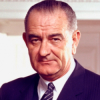
Lyndon B. Johnson
Lyndon Baines Johnson, often referred to as LBJ, was the 36th President of the United States from 1963 to 1969, assuming the office after serving as the 37th Vice President of the United States under President John F. Kennedy, from 1961 to 1963. Johnson was a Democrat from Texas, who served as a United States Representative from 1937 to 1949 and as a United States Senator from 1949 to 1961. He spent six years as Senate Majority Leader, two as...
NationalityAmerican
ProfessionUS President
Date of Birth27 August 1908
CountryUnited States of America
It means an educational system which does not simply equip the students to adjust to society, but which enables the student to challenge and to modify, and at times reject, if necessary, the received wisdom of his elders.
For it was only after I could become President of this country that I could really see in all its hopeful and troubling implications just how much the hopes of our citizens and the security of our Nation and the real strength of our democracy depended upon the learning and the understanding of our people.
We have always believed that our people can stand on no higher ground than the school ground, or can enter any more hopeful room than the classroom. We blend time and faith and knowledge in our schools - not only to create educated citizens, but also to shape the destiny of this great Republic.
This Congress did more to uplift education, more to attack disease in this country and around the world, and more to conquer poverty than any other session in all American history, and what more worthy achievements could any person want to have? For it was the Congress that was more true than any other Congress to Thomas Jefferson's belief that: 'The care of human life and happiness is the first and only legitimate objective of good Government.'
In the years since then, those four freedoms - freedom of speech, freedom of worship, freedom from want, and freedom from fear - have stood as a summary of our aspirations for the American Republic and for the world.
And Americans have always stood ready to pay the cost in energy and treasure which are needed to make those goals a reality.
Today - wealthier, more powerful and more able than ever before in our history - our Nation can declare another essential freedom.
The experts spent a great deal of time and study working out a formula which would be fair to every State and fair to every county and fair to every child, and would put the education dollar where that dollar is needed most, now.
Way back last summer I asked some of the most outstanding educational minds in this Nation to tackle this problem. I gave them a single instruction: find out how we can best invest each education dollar so that it will do the most good. Your support and the support of every leading education group proves that they did their job better than I had hoped, because for the first time we have succeeded in finding goals which unite us rather than divide us.
I don't think that I need to tell you how important to the outcome of that race is the education legislation that is now before the Congress. I hope that it is important enough that most of you have studied it in detail. I hope that you understand that it represents the very best thinking that the leading educators of this country can produce.
In many places, classrooms are overcrowded and curricula are outdated. Most of our qualified teachers are underpaid, and many of our paid teachers are unqualified. So we must give every child a place to sit and a teacher to learn from. Poverty must not be a bar to learning, and learning must offer an escape from poverty.
But more classrooms and more teachers are not enough. We must seek an educational system which grows in excellence as it grows in size. This means better training for our teachers. It means preparing youth to enjoy their hours of leisure as well as their hours of labor. It means exploring new techniques of teaching, to find new ways to stimulate the love of learning and the capacity for creation.
In addition to our existing programs, I will recommend a new program for schools and students with a first-year authorization of $1,500 million.
It will help at every state along the road to learning. For the pre-school years we will help needy children become aware of the excitement of learning.