Marcel Proust
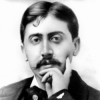
Marcel Proust
Valentin Louis Georges Eugène Marcel Proustwas a French novelist, critic, and essayist best known for his monumental novel À la recherche du temps perdu, published in seven parts between 1913 and 1927. He is considered by many to be one of the greatest authors...
NationalityFrench
ProfessionNovelist
Date of Birth10 July 1871
CountryFrance
love profound literature
What a profound significance small things assume when the woman we love conceals them from us.
lying cease
It is not only by dint of lying to others, but also of lying to ourselves, that we cease to notice that we are lying.
lying real might
How else learn the real, if not by inventing what might lie outside it?
believe thinking focus
To achieve accurate knowledge of others, if such a thing were possible, we could only ever arrive at it through the slow and unsure recognition of our own initial optical inaccuracies. However, such knowledge is not possible: for, while our vision of others is being adjusted, they, who are not made of mere brute matter, are also changing; we think we have managed to see them more clearly, but they shift; and when we believe we have them fully in focus, it is merely our older images of them that we have clarified, but which are themselves already out of date.
book reading successful
They like my books better in England than in France; a translation would be very successful there.
lying rely-upon done
Most of our faculties lie dormant because they can rely upon Habit, which knows what there is to be done and has no need of their services.
book reading kind
Every reader finds himself. The writer's work is merely a kind of optical instrument that makes it possible for the reader to discern what, without this book, he would perhaps never have seen in himself.
thinking opportunity interesting
One must never miss an opportunity of quoting things by others which are always more interesting than those one thinks up oneself.
lying heart doe
The heart does not lie.
believe states openness
We are at times too ready to believe that the present is the only possible state of things.
thinking people unhappy
People don't know when they are happy. They're never so unhappy as they think they are.
mean thinking afternoon
We may, indeed, say that the hour of death is uncertain, but when we say this we think of that hour as situated in a vague and remote expanse of time; it does not occur to us that it can have any connexion with the day that has already dawned and can mean that death -- or its first assault and partial possession of us, after which it will never leave hold of us again -- may occur this very afternoon, so far from uncertain, this afternoon whose time-table, hour by hour, has been settled in advance.
death thinking people
People do not die for us immediately, but remain bathed in a sort of aura of life which bears no relation to true immortality but through which they continue to occupy our thoughts in the same way as when they were alive. It is as though they were traveling abroad.
past giving effort
And so it is with our own past. It is a labour in vain to attempt to recapture it: all the efforts of our intellect must prove futile. The past is hidden somewhere outside the realm, beyond the reach of intellect, in some material object (in the sensation which that material object will give us) of which we have no inkling. And it depends on chance whether or not we come upon this object before we ourselves must die.