Martin Heidegger
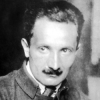
Martin Heidegger
Martin Heideggerwas a German philosopher and a seminal thinker in the Continental tradition and philosophical hermeneutics. According to the IEP, he is "widely acknowledged to be one of the most original and important philosophers of the 20th century." Heidegger is best known for his contributions to Phenomenology and Existentialism, though as the SEP cautions, "his thinking should be identified as part of such philosophical movements only with extreme care and qualification."...
NationalityGerman
ProfessionPhilosopher
Date of Birth26 September 1889
CountryGermany
he who thinks great thoughts often makes great errors
Is the earth in our head? Or do we stand on the earth?
Only a god can save us.
truth is that which makes a people certain, clear, and strong.
I see the situation of man in the world of planetary technicity not as an inexitricable and inescapable destiny, but I see the task of thought precisely in this, that within its own limits it helps man as such achieve a satisfactory relationship to the essence of technicity. National Socialism did indeed go in this direction. Those people, however, were far too poorly equipped for thought to arrive at a really explicit relationship to what is happening today and has been underway for the past 300 years
The world worlds, and is more fully in being than the tangible and perceptible realm in which we believe ourselves to be at home...By the opening up of a world, all things gain their lingering and hastening, their remoteness and nearness, their scope and limits. In a world's worlding is gathered that spaciousness out of which the protective grace of the gods is granted and withheld. Even this doom of the god remaining absent is a way in which the world worlds...All coming to presence...keeps itself concealed to the last.
Philosophy will not be able to effect an immediate transformation of the present condition of the world. This is not only true of philosophy, but of all merely human thought and endeavor.
Time is not a thing, thus nothing which is, and yet it remains constant in its passing away without being something temporal like the beings in time.
Thus "phenomenology" means αποφαινεσθαι τα φαινομενα -- to let that which shows itself be seen from itself in the very way in which it shows itself from itself.
From our human experience and history, at least as far as I am informed, I know that everything essential and great has only emerged when human beings had a home and were rooted in a tradition. Today's literature is, for instance, largely destructive.
The Fuhrer alone is the present and future German reality and its law. Learn to know ever more deeply: from now on every single thing demands decision, and every action responsibility.
In no way can it be uttered, as can other things, which one can learn. Rather, from out of a full, co-existential dwelling with the thing itself - as when a spark, leaping from the fire, flares into light - so it happens, suddenly, in the soul, there to grow, alone with itself.
Technology is therefore no mere means. Technology is a way of revealing. If we give heed to this, then another whole realm for the essence of technology will open itself up to us. It is the realm of revealing, i.e., of truth
In many places, above all in the Anglo-Saxon countries, logistics is today considered the only possible form of strict philosophy, because its result and procedures yield an assured profit for the construction of the technological universe. In America and elsewhere, logistics as the only proper philosophy of the future is thus beginning today to seize power over the intellectual world.