Max Weber
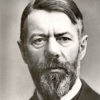
Max Weber
Karl Emil Maximilian "Max" Weberwas a German sociologist, philosopher, jurist, and political economist whose ideas profoundly influenced social theory and social research. Weber is often cited, with Émile Durkheim and Karl Marx, as among the three founders of sociology...
NationalityGerman
ProfessionPhilosopher
Date of Birth21 April 1864
CountryGermany
wish trying tasks
One cannot with impunity try to transfer this task entirely to mechanical assistants if one wishes to figure something, even though the final result is often small indeed.
writing ideas mind
Ideas come when we do not expect them, and not when we are brooding and searching at our desks. Yet ideas would certainly not come to mind had we not brooded at our desks and searched for answers with passionate devotion.
mind genius elements
The so-called materialistic conception of history, with the crude elements of genius of the early form which appeared, for instance, in the Communist Manifesto, still prevails only in the minds of laymen and dilettantes.
data age analysis
All research in the cultural sciences in an age of specialization, once it is oriented towards a given subject matter through particular settings of problems and has established its methodological principles, will consider the analysis of the data as an end in itself.
unity cost administration
Precision, speed, unambiguity, knowledge of files, continuity, discretion, unity, strict subordination, reduction of friction and of material and personal costs - these are raised to the optimum point in the strictly bureaucratic administration.
ethos organization purpose
Puritanism carried the ethos of the rational organization of capital and labor. It took over from the Jewish ethic only what was adapted to this purpose.
clubs ethics cult
A highly developed stock exchange cannot be a club for the cult of ethics.
hard-work fate years
[In] the realm of science, ... what we have achieved will be obsolete in ten, twenty or fifty years. That is the fate, indeed, that is the very meaning of scientific work. ... Every scientific "fulfillment" raises new "questions" and cries out to be surpassed rendered obsolete. Everyone who wishes to serve science has to resign himself to this.
truth-is
The Truth is the Truth.
meaningful judging matter
Only on the assumption of belief in the validity of values is the attempt to espouse value-judgments meaningful. However, to judge the validity of such values is a matter of faith .
earning ethics puritan
The summum bonum of this [Puritan] ethic is the earning of more and more money combined with the strict avoidance of all enjoyment.
integrity intellectual lectures
Within the confines of the lecture hall, no other virtue exists but plain intellectual integrity.
analysis judgment explanation
Causal analysis provides absolutely no value judgment, and a value judgment is absolutely not a causal explanation.
accomplishment today lifetime
Only by strict specialization can the scientific worker become fully conscious, for once and perhaps never again in his lifetime, that he has achieved something that will endure. A really definitive and good accomplishment is today always a specialized act.