Murray Gell-Mann
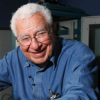
Murray Gell-Mann
Murray Gell-Mannis an American physicist who received the 1969 Nobel Prize in physics for his work on the theory of elementary particles. He is the Robert Andrews Millikan Professor of Theoretical Physics Emeritus at the California Institute of Technology, a Distinguished Fellow and co-founder of the Santa Fe Institute, Professor in the Physics and Astronomy Department of the University of New Mexico, and the Presidential Professor of Physics and Medicine at the University of Southern California. Gell-Mann has spent several...
NationalityAmerican
ProfessionScientist
Date of Birth15 September 1929
CityNew York City, NY
CountryUnited States of America
So the old Copenhagen interpretation needs to be generalized, needs to be replaced by something that can be used for the whole universe, and can be used also in cases where there is plenty of individuality and history
Sometimes the probabilities are very close to certainties, but they're never really certainties
Planets are too dim to be detected with existing equipment, far away, except in these very special circumstances where they're seen by their gravitational effect
Niels Bohr brainwashed a whole generation of theorists into thinking that the job (interpreting quantum theory) was done 50 years ago.
Of course the word chaos is used in rather a vague sense by a lot of writers, but in physics it means a particular phenomenon, namely that in a nonlinear system the outcome is often indefinitely, arbitrarily sensitive to tiny changes in the initial condition
If someone says that he can think or talk about quantum physics without becoming dizzy, that shows only that he has not understood anything whatever about it.
If I have seen further than others, it is because I am surrounded by dwarfs.
The chaos can act as a magnifier of quantum fluctuations so that they can produce sizable effects in the world around us. But we know that that can happen often
The mathematics clearly called for a set of underlying elementary objects-at that time we needed three types of them-elementary objects that could be combined three at a time in different ways to make all the heavy particles we knew. ... I needed a name for them and called them quarks, after the taunting cry of the gulls, "Three quarks for Muster mark," from Finnegan's Wake by the Irish writer James Joyce.
Three principles - the conformability of nature to herself, the applicability of the criterion of simplicity, and the "unreasonable effectiveness" of certain parts of mathematics in describing physical reality - are thus consequences of the underlying law of the elementary particles and their interactions. Those three principles need not be assumed as separate metaphysical postulates. Instead, they are emergent properties of the fundamental laws of physics.
I thought of killing myself but soon decided that I could always try MIT and then kill myself later if it was that bad but that I couldn't commit suicide and then try MIT afterwards. The two operations, suicide and going to MIT, don't commute...
I would recommend that skeptics devote even more effort than they do now to understanding the reasons why so many people want or need to believe.
Sustainability is living on nature's income rather than living on its capital.
Everything that is not forbidden is compulsory.