Murray Gell-Mann
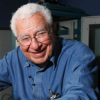
Murray Gell-Mann
Murray Gell-Mannis an American physicist who received the 1969 Nobel Prize in physics for his work on the theory of elementary particles. He is the Robert Andrews Millikan Professor of Theoretical Physics Emeritus at the California Institute of Technology, a Distinguished Fellow and co-founder of the Santa Fe Institute, Professor in the Physics and Astronomy Department of the University of New Mexico, and the Presidential Professor of Physics and Medicine at the University of Southern California. Gell-Mann has spent several...
NationalityAmerican
ProfessionScientist
Date of Birth15 September 1929
CityNew York City, NY
CountryUnited States of America
What is especially striking and remarkable is that in fundamental physics a beautiful or elegant theory is more likely to be right than a theory that is inelegant.
Now, what that means is that there is fundamental indeterminacy from quantum mechanics, but besides that there are other sources of effective indeterminacy.
Well, I don't like to get involved in these philosophical issues very much.
Is it imaginable that in the 13 or 14 billion years before human life appeared there was no quantum mechanics? That is ludicrous.
You know, there was a time, just before I started to study physical science, when astronomers thought that systems such as we have here in the solar system required a rare triple collision of stars
The world of the quark has everything to do with a jaguar circling in the night.
But I don't actually adopt the point of view that our subjective impression of free will, which is a kind of indeterminacy behavior, comes from quantum mechanical indeterminacy.
I am frequently astonished that it so often results in correct predictions of experimental results.
I do not keep up with the details of particle physics.
I have been interested in phenomena involving complexity, diversity and evolution since I was a young boy.
In fact any experiment that measures a quantum effect is one in which the quantum effect is aligned with the behavior of some heavy, macroscopic object; that's how we measure it
As a theoretical physicist, I feel at once proud and humble at the thought of the illustrious figures that have preceded me here to receive the greatest of all honors in science, the Nobel prize.
But when researchers at Bell Labs discovered that static tends to come from particular places in the sky, the whole field of radio astronomy opened up.
If we look at the way the universe behaves, quantum mechanics gives us fundamental, unavoidable indeterminacy, so that alternative histories of the universe can be assigned probability.