Murray Rothbard
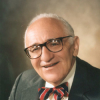
Murray Rothbard
Murray Newton Rothbardwas an American heterodox economist of the Austrian School, a revisionist historian, and a political theoristwhose writings and personal influence played a seminal role in the development of modern libertarianism. Rothbard was the founder and leading theoretician of anarcho-capitalism, a staunch advocate of historical revisionism, and a central figure in the twentieth-century American libertarian movement. He wrote over twenty books on political theory, revisionist history, economics, and other subjects. Rothbard asserted that all services provided by the "monopoly...
NationalityAmerican
ProfessionHistorian
Date of Birth2 March 1926
CountryUnited States of America
Positivism eliminates any kind of natural law principle - for example, that there are economic laws which can be transgressed only at your peril. With positivism, there is a tendency to leap into ad hoc economic theory.
One of the most important features of our economic resources is their scarcity: land, labor, and capital goods factors are all scarce, and may all be put to various possible uses. The free market uses them 'productively' because the producers are guided, on the market, to produce what the consumers most need: automobiles, for example, rather than buggies.
Early economic theory was rooted in the Italian, French, and Spanish traditions, which were subjectivist oriented. Then it shifted onto the terrible path by Smith and Ricardo and the British classical tradition, which is 'objectivist' - values are in inherent in production.
[W]hich category of crimes does the State pursue and punish most intensely? [T]hose against private citizens or those against itself? The gravest crimes in the State's lexicon are almost invariably not invasions of private person or property, but dangers to its own contentment, for example, treason, desertion of a soldier to the enemy, failure to register for the draft, subversion and subversive conspiracy, assassination of rulers and such economic crimes against the State as counterfeiting its money or evasion of its income tax.
Only the State legally obtains its revenue by coercion.
Modern economics is a set of formal models and equations purporting to fully determine human behaviour, at least in the economic realm. And there is no way that uncertainty can be compressed into determinate mathematical models.
The ingenious slogan that the public debt does not matter because 'we owe it to ourselves' is clearly absurd.
Liberty and morality had to win their way slowly over many centuries, until finally expanding liberty made possible the great technological advance of the Industrial Revolution and the flowering of modern capitalism.
The more these readjustments are delayed ... the longer the depression will have to last, and the longer complete recovery is postponed.
So: if the chronic inflation undergone by Americans, and in almost every other country, is caused by the continuing creation of new money, and if in each country its governmental "Central Bank" (in the United States, the Federal Reserve) is the sole monopoly source and creator of all money, who then is responsible for the blight of inflation? Who except the very institution that is solely empowered to create money, that is, the Fed (and the Bank of England, and the Bank of Italy, and other central banks) itself?
Instead of a bumbling and inefficient tool of society, the radical [libertarian] sees the State itself, in its very nature, as coercive, exploitative, parasitic, and hence profoundly antisocial. The State is, and always has been, the great single enemy of the human race, its liberty, happiness, and progress.
The state has typically been a device for producing affluence for a few at the expense of many.
This process, this method necessary to man's survival and prosperity upon the earth, has often been derided as unduly or exclusively "materialistic." But it should be clear that what has happened in this activity proper to man's nature is a fusion of "spirit" and matter; man's mind, using the ideas it has learned, directs his energy in transforming and reshaping matter into ways to sustain and advance his wants and his life. Behind every "produced" good, behind every man-made transformation of natural resources, is an idea directing the effort, a manifestation of man's spirit.
There can be no truly moral choice unless that choice is made in freedom; similarly, there can be no really firmly grounded and consistent defense of freedom unless that defense is rooted in moral principle.