Nhat Hanh
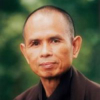
Nhat Hanh
Thích Nhất Hạnh; born as Nguyen Xuan Bao on October 11, 1926) is a Vietnamese Buddhist monk and peace activist. He lives in Plum Village in the Dordogne region in the south of France, travelling internationally to give retreats and talks. He coined the term "Engaged Buddhism" in his book Vietnam: Lotus in a Sea of Fire. A long-term exile, he was given permission to make his first return trip to Vietnam in 2005...
NationalityVietnamese
ProfessionActivist
Date of Birth11 October 1926
CountryVietnam
The miracle is not to walk on water, or in the air, or on burning charcoal. The miracle is to walk on earth. You breathe in, you become aware of the fact that you are alive. You are alive and you are walking on this beautiful planet. The greatest of of all miracles is to be alive.
It's like a mother, when the baby is crying, she picks up the baby and she holds the baby tenderly in her arms. Your pain, your anxiety is your baby. You have to take care of it. You have to go back to yourself, to recognize the suffering in you, embrace the suffering, and you get a relief.
If we are not empty, we become a block of matter. We cannot breathe, we cannot think. To be empty means to be alive, to breathe in and to breathe out. We cannot be alive if we are not empty. Emptiness is impermanence, it is change. We should not complain about impermanence, because without impermanence, nothing is possible.
In the Light of interbeing, peace and happiness in your daily life means peace and happiness in the world.
Scientists tell us that we have enough technology to save our planet. . . . Yet we don't take advantage of this new technology. . . . The technological has to work hand-in-hand with the spiritual. Our spiritual life is the element that can bring about the energies of peace, calm, brotherhood, understanding, and compassion. Without that, our planet doesn't stand a chance.
In the past there were people who were not rich but contented with their living style, laughing and happy all day. But when the new rich people appear, people look at them and ask, 'why don't I have a life like that too, a beautiful house, car and garden,' and they abandon their values.
Breathe in deeply to bring your mind home to your body. Then look at, or think of, the person triggering this emotion: With mindfulness, you can see that she is unhappy, that she is suffering. You can see her wrong perceptions. You can see that she is not beautiful when she says things that are unkind.
Be mindful 24 hours a day, not just during the one hour you may allot for formal meditation or reading scripture and reciting prayers. Each act must be carried out in mindfulness.
If we practice mindfulness, we always have a place to be when we are afraid.
I am determined not to kill, not to let others kill, and not to condone any act of killing in the world, in my thinking, and in my way of life. We cannot support any act of killing; no killing can be justified. But not to kill is not enough ... If in your thinking you allow the killing to go on, you also break this precept. We must be determined not to condone killing, even in our minds.
To condemn someone to death is to surrender; it proves that you failed. You are not able to change him, to change her; you have to kill him or her. You surrender. ... You only demonstrate your lack of capacity, your helplessness. This is failure.
Reconciliation is a deep practice that we can do with our listening and our mindful speech. To reconcile means to bring peace and happiness to nations, people, and members of our family.... In order to reconcile, you have to possess the art of deep listening.
Live the actual moment. Only this moment is life.
Wisdom is a living stream, not an icon to be preserved in a museum. Only when a practitioner finds the spring of wisdom in his or her own life can it flow to a future generation