Paul Celan
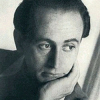
Paul Celan
Paul Celanwas a Romanian-born German language poet and translator. He was born as Paul Antschel to a Jewish family in Cernăuți, in the then Kingdom of Romania, and adopted the pseudonym "Paul Celan".. He became one of the major German-language poets of the post-World War II era...
NationalityRomanian
ProfessionPoet
Date of Birth23 November 1920
CountryRomania
eye blood wind
With a changing key, you unlock the house where the snow of what’s silenced drifts. Just like the blood that bursts from Your eye or mouth or ear, so your key changes. Changing your key changes the word That may drift with flakes. Just like the wind that rebuffs you, Clenched round your word is the snow.
heart two silence
The two heart-grey puddles: two mouthsfull of silence.
bears witness
no one bears witness for the witness
spring bird tree
Spring: trees flying up to their birds
lasts splinters knots
How you die out in me: down to the last worn-out knot of breath you're there, with a splinter of life.
reality land hopeful
A poem, as a manifestation of language and thus essentially dialogue, can be a message in a bottle, sent out in the –not always greatly hopeful-belief that somewhere and sometime it could wash up on land, on heartland perhaps. Poems in this sense too are under way: they are making toward something. Toward what? Toward something standing open, occupiable, perhaps toward an addressable Thou, toward an addressable reality.
names world manifold
Don't sign your name between worlds, surmount the manifold of meanings, trust the tearstain, learn to live.
earth
There was earth inside them, and they dug.
air roots remains
in the air, there your root remains, there, in the air
homecoming poetry-is
Poetry is a sort of homecoming.
strong world hours
Illegibility of this world. All things twice over. The strong clocks justify the splitting hour, hoarsely. You , clamped into your deepest part, climb out of yourself for ever.
wine snow lasts
With wine and being lost, with less and less of both: I rode through the snow, do you read me I rode God far--I rode God near, he sang, it was our last ride over the hurdled humans. They cowered when they heard us overhead, they wrote, they lied our neighing into one of their image-ridden languages.
mad happenings
We are told that when Hölderlin went 'mad,' he constantly repeated, 'Nothing is happening to me, nothing is happening to me.'
running art lying
Poetry is perhaps this: an Atemwende, a turning of our breath. Who knows, perhaps poetry goes its way—the way of art—for the sake of just such a turn? And since the strange, the abyss and Medusa’s head, the abyss and the automaton, all seem to lie in the same direction—is it perhaps this turn, this Atemwende, which can sort out the strange from the strange? It is perhaps here, in this one brief moment, that Medusa’s head shrivels and the automaton runs down? Perhaps, along with the I, estranged and freed here, in this manner, some other thing is also set free?