Paul Klee
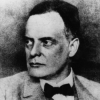
Paul Klee
Paul Kleewas a Swiss-German artist. His highly individual style was influenced by movements in art that included Expressionism, Cubism, and Surrealism. Klee was a natural draftsman who experimented with and eventually deeply explored color theory, writing about it extensively; his lectures Writings on Form and Design Theory, published in English as the Paul Klee Notebooks, are held to be as important for modern art as Leonardo da Vinci's A Treatise on Painting for the Renaissance. He and his colleague, Russian...
NationalitySwiss
ProfessionPainter
Date of Birth18 December 1879
CityMunchenbuchsee, Switzerland
CountrySwitzerland
The worst state of affairs is when science begins to concern itself with art.
For the understanding of a picture a chair is needed. Why a chair? To prevent the legs, as they tire, from interfering with the mind
I want to be as though newborn. To be almost primitive.
Light and the rational forms are locked in combat; light sets them into motion, bends what is straight, makes parallels oval, inscribes circles in the intervals, makes the intervals active.
The beautiful, which is perhaps inseparable from art, is not after all tied to the subject, but to the pictorial representation. In this way and in no other does art overcome the ugly without avoiding it.
I must begin, not with hypothesis, but with specific instances, no matter how minute.
Nature is garrulous to the point of confusion, let the artist be truly taciturn.
Be winged arrows aiming at fulfillment and goal.
In the final analysis, a drawing simply is no longer a drawing, no matter how self-sufficient its execution may be. It is a symbol, and the more profoundly the imaginary lines of projection meet higher dimensions, the better.
From the root, the sap rises up into the artist, flows through him, flows to his eye. Overwhelmed and activated by the force of the current, he conveys his vision into his work. And yet, standing at his appointed place as the trunk of the tree, he does nothing other than gather and pass on what rises from the depths. He neither serves nor commands he transmits. His position is humble. And the beauty at the crown is not his own; it has merely passed through him.
One day I will lie nowhere with an angel at my side.
There is plenty of room left for exact experiment in art, and the gate has been opened for some time. What had been accomplished in music by the end of the eighteenth century has only begun in the fine arts. Mathematics and physics have given us a clue in the form of rules to be strictly observed or departed from, as the case may be. Here salutary discipline is come to grips first of all with the function of forms, and not with form as the final result … in this way we learn how to look beyond the surface and get to the root of things.
Reduction! One wants to say more than nature and one makes the impossible mistake of wanting to say it with more means than she, instead of fewer.
Nature can afford to be prodigal in everything, the artist must be frugal down to the last detail.Nature is garrulous to the point of confusion, let the artist be truly taciturn.