Paul Wolfowitz
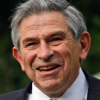
Paul Wolfowitz
Paul Dundes Wolfowitzis a former President of the World Bank, United States Ambassador to Indonesia, U.S. Deputy Secretary of Defense, and former dean of the Paul H. Nitze School of Advanced International Studies at Johns Hopkins University. He is currently a visiting scholar at the American Enterprise Institute, working on issues of international economic development, Africa and public-private partnerships, and chairman of the US-Taiwan Business Council...
NationalityAmerican
ProfessionPublic Servant
Date of Birth22 December 1943
CountryUnited States of America
I think Indian officials that I talk to aren't satisfied with the seven per cent or so that they're doing, but I must say that is impressive already, and I think they are making every effort to do more.
Unless serious concessions are made by all sides ... the Doha round of trade talks will fail and the people who will suffer the most are the world's poor.
It would be to the benefit not only of Turkey and Europe but to the entire world, including my country, if the December 12 European Union summit in Copenhagen can succeed in advancing two important goals -- a settlement in Cyprus and an agreement on a date to begin talks on Turkish membership in the EU.
You're not going to find it in a house-to-house search. You're going to find it when people start to talk to you, and we're in the process of finding the people who can talk,
is a danger we can't afford to live with indefinitely.
People are entitled to present their views any way they want to, entitled to present uninformed views as well as informed ones.
We have agreement on more aid, we have consensus on debt relief -- now let's complete the picture and deliver a true development round on trade.
Our focus right now is in getting rid of this regime in Baghdad.
Jobs are a priority for every country, ... Doing more to improve regulation and help entrepreneurs is the key to creating jobs - and more growth.
I think it is important, this issue of voice, which is shorthand for how, to have particularly developing countries have more of a say in the operations of institutions like this one. It is a very important question,
We can't commit money unless we're convinced it is going to be spent in the right way,
Some of the poorest developing countries lack the resources, for example, to pay farmers adequately to get rid of sick chickens.
Someone once said that history has more imagination than all the scenario writers in the Pentagon, and we have a lot of scenario writers here. No one ever wrote a scenario for commercial airliners crashing into the World Trade Center.
Some kind of adjustment is necessary, but I think it should be done in a way that it reflects efficient market allocation of energy resources.