Rabindranath Tagore
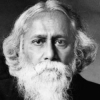
Rabindranath Tagore
Rabindranath Tagore FRAS, also written Ravīndranātha Thākura, sobriquet Gurudev, was a Bengali polymath who reshaped Bengali literature and music, as well as Indian art with Contextual Modernism in the late 19th and early 20th centuries. Author of Gitanjali and its "profoundly sensitive, fresh and beautiful verse", he became the first non-European to win the Nobel Prize in Literature in 1913. In translation his poetry was viewed as spiritual and mercurial; however, his "elegant prose and magical poetry" remain largely unknown...
NationalityIndian
ProfessionPoet
Date of Birth7 May 1861
CityKolkata, India
CountryIndia
So our daily worship of God is not really the process of gradual acquisition of him, but the daily process of surrendering ourselves, removing all obstacles to union and extending our consciousness of him in devotion and service, in goodness and in l
Science urges us to occupy by our mind the immensity of the knowable world; our spiritual teacher enjoins us to comprehend by our soul the infinite spirit which is in the depth of the moving and changing facts of the world; the urging of our artistic
The revilement of the infinite in the finite, which is the motive of all creation, is not seen in its perfection in the starry heavens, in the beauty of the flowers. It is in the soul of man.
Your mission is proving that a love for the earth, and for the things of the earth, is possible without materialism, a love without greed... I entreat you not to be turned by the call of vulgar strength, of stupendous size, by the spirit of storage,
The most important lesson that man can learn from his life is not that there is pain in this world, but that it depends upon him to turn it into good account, that it is possible for him to transmute it into joy... Man's freedom is never in being sav
The burden of self is lightened when I laugh at myself.
Our nature is obscured by work done by the compulsion of want or fear. The mother reveals herself in the service of her children, so our true freedom is not the freedom from action but freedom in action, which can only be attained in the work of love.
We live in this world when we love it.
In the dualism of death and life there is a harmony. We know that the life of a soul, which is finite in its expression and infinite in its principle, must go through the portals of death in its journey to realize the infinite. It is death which is m
In our desire for eternal life we pray for an eternity of our habit and comfort, forgetting that immortality is in repeatedly transcending the definite forms of life in order to pursue the infinite truth of life.
In love, at one of its poles you find the personal, at the other the impersonal. At one you have the positive assertion - Here I am; at the other the equally strong denial - I am not. Without this ego what is love? And again, with only this ego how c
In love all the contradiction of existence merge themselves and are lost. Only in love are unity and duality not at variance. Love must be one and two at the same time. Only love is motion and rest in one. Our heart ever changes its place till it fin
I miss the meaning of my own part in the play of life because I know not the parts that others play
I have no faith in my works. I know time's ocean, its lashing of waves, day by day, will erase them. My faith is in my self.