Rabindranath Tagore
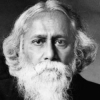
Rabindranath Tagore
Rabindranath Tagore FRAS, also written Ravīndranātha Thākura, sobriquet Gurudev, was a Bengali polymath who reshaped Bengali literature and music, as well as Indian art with Contextual Modernism in the late 19th and early 20th centuries. Author of Gitanjali and its "profoundly sensitive, fresh and beautiful verse", he became the first non-European to win the Nobel Prize in Literature in 1913. In translation his poetry was viewed as spiritual and mercurial; however, his "elegant prose and magical poetry" remain largely unknown...
NationalityIndian
ProfessionPoet
Date of Birth7 May 1861
CityKolkata, India
CountryIndia
The trees come up to my window like the yearning voice of the dumb earth
The soil in return for her service keeps the tree tied to her, the sky asks nothing and leaves it free.
Emancipation from the bondage of the soil is no freedom for the tree.
The birth and death of leaves is part of that greater cycle that moves among the stars.
The one who plants trees, knowing that he will never sit in their shade, has at least started to understand the meaning of life.
Languages are jealous sovereigns, and passports are rarely allowed for travelers to cross their strictly guarded borders
Man's cry is to reach his fullest expression.
Some have thought deeply and explored the meaning of thy truth, and they are great; I have listened to catch the music of thy play, and I am glad
Nationality is respectable only when it is on the defense, when it is waging wars of liberation it is sacred; when those of domination it is accursed.
Let me not pray to be sheltered from dangers, but to be fearless in facing them. Let me not beg for the stilling of my pain, but for the heart to conquer it.
Truth cannot afford to be tolerant where it faces positive evil.
There are men whose idea of life is tactic, who long for its continuation after death only because of their wish for permanence and not perfection; they love to imagine that the things to which they are accustomed will persist for ever. They complete
The progress of our soul is like a perfect poem. It has an infinite idea which once realized makes all movements full of meaning and joy. But if we detach its movements from that ultimate idea, if we do not see the infinite rest and only see the infi
The question why there is evil in existence is the same as why there is imperfection... But this is the real question we ought to ask: Is this imperfection the final truth, is evil absolute and ultimate?