Ralph Ellison
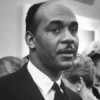
Ralph Ellison
Ralph Waldo Ellisonwas an American novelist, literary critic, and scholar. He was born in Oklahoma City, Oklahoma. Ellison is best known for his novel Invisible Man, which won the National Book Award in 1953. He also wrote Shadow and Act, a collection of political, social and critical essays, and Going to the Territory. For The New York Times, the best of these essays in addition to the novel put him "among the gods of America's literary Parnassus." A posthumous novel,...
NationalityAmerican
ProfessionNovelist
Date of Birth1 March 1914
CityOklahoma City, OK
CountryUnited States of America
If social protest is antithetical to art, what then shall we make of Goya, Dickens, and Twain?
The act of writing requires a constant plunging back into the shadow of the past where time hovers ghostlike.
Every serious novel is, beyond its immediate thematic preoccupations, a discussion of the craft, a conquest of the form, a conflict with its difficulties and a pursuit of its felicities and beauty.
The world is a possibility if only you'll discover it.
The blues is an impulse to keep the painful details and episodes of a brutal experience alive in one's aching consciousness, to finger its jagged grain, and to transcend it, not by the consolation of philosophy but by squeezing from it a near-tragic, near-comic lyricism. As a form, the blues is an autobiographical chronicle of personal catastrophe expressed lyrically.
We look too much to museums. The sun coming up in the morning is enough.
It took me a long time and much painful boomeranging of my expectations to achieve a realization everyone else appears to have been born with: That I am nobody but myself.
Good fiction is made of that which is real, and reality is difficult to come by.
Had the price of looking been blindness, I would have looked.
There must be possible a fiction which, leaving sociology and case histories to the scientists, can arrive at the truth about the human condition, here and now, with all the bright magic of the fairy tale.
I am one of the most irresponsible beings that ever lived. Irresponsibility is part of my invisibility; any way you face it, it is a denial. But to whom can I be responsible, and why should I be, when you refuse to see me?
The blues is an art of ambiguity, an assertion of the irrepressibly human over all circumstance whether created by others or by one's own human failings. They are the only consistent art in the United States which constantly remind us of our limitations while encouraging us to see how far we can actually go. When understood in their more profound implication, they are a corrective, an attempt to draw a line upon man's own limitless assertion.
It goes a long way back, some twenty years. All my life I had been looking for something, and everywhere I turned someone tried to tell me what it was. I accepted their answers too, though they were often in contradiction and even self-contradictory. I was naive. I was looking for myself and asking everyone except myself questions which I, and only I, could answer. It took me a long time and much painful boomeranging of my expectations to achieve a realization everyone else appears to have been born with: That I am nobody but myself. But first I had to discover that I am an invisible man!
So why do I write, torturing myself to put it down? Because in spite of myself I've learned some things. Without the possibility of action, all knowledge comes to one labeled "file and forget," and I can neither file nor forget. Nor will certain ideas forget me; they keep filing away at my lethargy, my complacency. Why should I be the one to dream this nightmare?