Robert Kennedy
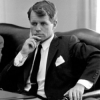
Robert Kennedy
Robert Francis "Bobby" Kennedy, commonly known by his initials RFK, was an American politician from Massachusetts. He served as a senator for New York from 1965 until his assassination in 1968. He was previously the 64th U.S. Attorney General from 1961 to 1964, serving under his older brother, President John F. Kennedy and his successor, President Lyndon B. Johnson. An icon of modern American liberalism and member of the Democratic Party, Kennedy ran for the Democratic presidential nomination in the...
NationalityAmerican
ProfessionPolitician
Date of Birth20 November 1925
CountryUnited States of America
Whenever men take the law into their own hands, the loser is the law. And when the law loses, freedom languishes.
Sometimes people think that because you have money and position you are immune from the human experience. But I can feel as lonesome and lost as the next man when I turn the key in the door and go into an empty house that is usually full of kids and dogs.
Killing one man is murder. Killing millions is a statistic
At the heart of western freedom and democracy is the belief that the individual man ... is the touchstone of value, and all society, groups, the state, exist for his benefit. Therefore the enlargement of liberty for individual human beings must be the supreme goal and abiding practice of any western society.
I believe that as long as a single man may try, any unjustifiable barrier against his efforts is a barrier against mankind.
Men and women with freed minds may often be mistaken, but they are seldom fooled. They may be influenced, but they cannot be intimidated. They may be perplexed, but they will never be lost.
Like it or not we live in interesting times. They are times of danger and uncertainty; but they are also more open to the creative energy of men than any other time in history. And everyone here will ultimately be judged - will ultimately judge himself - on the effort he has contributed to building a new world society and the extent to which his ideals and goals have shaped that effort.
Men without hope, resigned to despair and oppression, do not make revolutions. It is when expectation replaces submission, when despair is touched with the awareness of possibility, that the forces of human desire and the passion for justice are unloosed.
The essential humanity of men can be protected and preserved only where government must answer, not just to the wealthy, not just to those of a particular religion, or a particular race, but to all its people.
The road toward equality of freedom is not easy, and great cost and danger march alongside us. We are committed to peaceful and nonviolent change, and that is important for all to understand - though all change is unsettling. Still, even in the turbulence of protest and struggle is greater hope for the future, as men learn to claim and achieve for themselves the rights formerly petitioned from others.
Some men see what is, and ask 'Why?' I see what might be, and ask 'Why Not?'
All do not develop in the same manner, or at the same pace. Nations, like men, often march to the beat of different drummers, and the precise solutions of the United States can neither be dictated nor transplanted to others. What is important is that all nations must march toward increasing freedom; toward justice for all; toward a society strong and flexible enough to meet the demands of all its own people, and a world of immense and dizzying change.
Democracy is no easy form of government. Few nations have been able to sustain it. For it requires that we take the chances of freedom; that the liberating play of reason be brought to bear on events filled with passion; that dissent be allowed to make its appeal for acceptance; that men chance error in their search for the truth.
Our attitude towards immigration reflects our faith in the American ideal. We have always believed it possible for men and women who start at the bottom to rise as far as the talent and energy allow. Neither race nor place of birth should affect their chances.