Rudolf Steiner
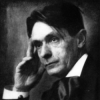
Rudolf Steiner
Rudolf Joseph Lorenz SteinerFebruary 1861 – 30 March 1925) was an Austrian philosopher, social reformer, architect and esotericist. Steiner gained initial recognition at the end of the nineteenth century as a literary critic and published philosophical works including The Philosophy of Freedom. At the beginning of the twentieth century he founded an esoteric spiritual movement, anthroposophy, with roots in German idealist philosophy and theosophy; other influences include Goethean science and Rosicrucianism...
NationalityAustrian
ProfessionPhilosopher
Date of Birth5 February 1861
CountryAustria
Rudolf Steiner quotes about
We must be educated in inner human modesty, so we can recognize that we are not, even for a moment, complete as human beings. Instead, we continue to develop from birth until death. We must recognize that every day of life has a special value, that it is not without purpose that we must learn to live through our thirties right after we have just gone through our twenties. We need to learn that each new day and each new year offers continual revelation.
You will not be good teachers if you focus only on what you do and not upon who you are.
Love is higher than opinion. If people love one another the most varied opinions can be reconciled - thus one of the most important tasks for humankind today and in the future is that we should learn to live together and understand one another. If this human fellowship is not achieved, all talk of development is empty.
May my soul bloom in love for all existence.
When human beings meet together seeking the spirit with unity of purpose then they will also find their way to each other ...
To be free is to be capable of thinking one's own thoughts - not the thoughts merely of the body, or of society, but thoughts generated by one's deepest, most original, most essential and spiritual self, one's individuality.
Where is the book in which the teacher can read about what teaching is? The children themselves are this book. We should not learn to teach out of any book other than the one lying open before us and consisting of the children themselves.
Music is the expression of the will of nature while all other arts are expressions of the idea of nature.
Goethe's thinking was not rigid with inflexible contours; it was a thinking in which the concepts continually metamorphose.
The task of understanding is not to replicate in conceptual form something that already exists, but rather to create a wholly new realm, that together with the world given to our senses constitutes the fullness of reality.
When we feel an obligation to test the things we say and to find the boundaries within which what we say has validity, then we are contributing to a real inner consolidation of our human feeling for existence.
When man faces man the one attempts to put the other to sleep and the other continuously wants to maintain his uprightness. But this is, to speak in the Goethean sense, the archetypal phenomenon of social science. This sleeping-into we may call the social principle, the social impulse of the new era: we have to live over into the other; we have to dissolve with our soul into the other.
Because of their very nature, science and logical thinking can never decide what is possible or impossible. Their only function is to explain what has been ascertained by experience and observation.
It is the death of present art when it returns again and again to the model. Use of the model is only an intermediate stage in artistic development. Create out of a living spirituality to overcome everything naturalistic.