Rupert Sheldrake
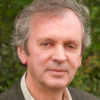
Rupert Sheldrake
Alfred Rupert Sheldrakeis an English author, public speaker, and researcher in the field of parapsychology, known for his "morphic resonance" concept. He worked as a biochemist and cell biologist at Cambridge University from 1967 to 1973 and as principal plant physiologist at the International Crops Research Institute for the Semi-Arid Tropics until 1978...
NationalityBritish
ProfessionScientist
Date of Birth28 June 1942
speech fields culture
Basically, morphic fields are fields of habit, and they've been set up through habits of thought, through habits of activity, and through habits of speech. Most of our culture is habitual...
art creativity air
Creativity gives new forms, new patterns, new ideas, new art forms. And we don't know where creativity comes from. Is it inspired from above? Welling up from below? Picked up from the air? What? Creativity is a mystery wherever you encounter it...
reality filled-in leaving
The Science Delusion is the belief that science already understands the nature of reality in principle leaving only the details to be filled in.
creative ongoing principles
The universe is not in a steady state; there's an ongoing creative principle in nature, which is driving things onwards.
backed british-scientist point science talk thousands tons
The point of what I'm doing is to talk not about science backed up by hundreds of committees, thousands of professors, and many tons of textbooks.
people failing science-and-religion
In both religion and science, some people are dishonest, exploitative, incompetent and exhibit other human failings.
art school successful
A lot of us have all sorts of ideas, and we select some rather than others and give expression to those... and some works of art are more successful than others. Some languish in obscurity and are never heard of again, while others form the foundation of a whole school of art.
believe hardened held maintained powerful sciences
The sciences are being held back by assumptions that have hardened into dogmas, maintained by powerful taboos. I believe that the sciences will be regenerated when they are set free.
mother names views
The Gaia Hypothesis of James Lovelock [and Lynn Margulis] puts forward a scientific view of the living Earth, which in one respect is modern, empherical, scientific, in another respect re-awakens an ancient archetype, which in fact is so clearly suggested by the very name of the hypothesis, Gaia, the Greek name for Mother Earth.
mean chaos randomness
If there is no randomness in the universe, then what do we mean by chaos?
art successful ideas
Not every good idea survives. Not every new form of art is repeated. Not every new potential instinct is successful. Only the successful ones get repeated. By natural selection and then through repetition they become probable, more habitual.
real technology thinking
The facts of science are real enough, and so are the techniques that scientists use, and so are the technologies based on them. But the belief system that governs conventional scientific thinking is an act of faith.