Samuel Johnson
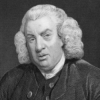
Samuel Johnson
Samuel Johnson, often referred to as Dr Johnson, was an English writer who made lasting contributions to English literature as a poet, essayist, moralist, literary critic, biographer, editor and lexicographer. Johnson was a devout Anglican and committed Tory, and has been described as "arguably the most distinguished man of letters in English history". He is also the subject of "the most famous single biographical work in the whole of literature," James Boswell's Life of Samuel Johnson...
NationalityEnglish
ProfessionNon-Fiction Author
Date of Birth18 September 1709
Integrity without knowledge is weak and useless. Knowledge without integrity is dangerous and dreadful.
These are the men who, without virtue, labour, or hazard, are growing rich, as their country is impoverished; they rejoice, when obstinacy or ambition adds another year to slaughter and devastation; and laugh, from their desks, at bravery and science, while they are adding figure to figure, and cipher to cipher, hoping for a new contract from a new armament, and computing the profits of a siege or tempest.
Integrity without knowledge is weak and useless, and knowledge without integrity is dangerous and dreadful.
Marriage is the strictest tie of perpetual friendship, and there can be no friendship without confidence, and no confidence without integrity; and he must expect to be wretched, who pays to beauty, riches, or politeness that regard which only virtue and piety can claim.
In matters of business, no woman stops at integrity.
Economy is the parent of integrity, of liberty, and of ease, and the beauteous sister of temperance, of cheerfulness and health.
The fortitude which has encountered no dangers, that prudence which has surmounted no difficulties, that integrity which has been attacked by no temptation, can at best be considered but as gold not yet brought to the test, of which therefore the true value cannot be assigned.
The whole power of cunning is privative; to say nothing, and to do nothing , is the utmost of its reach. Yet men, thus narrow by nature and mean by art, are sometimes able to rise by the miscarriages of bravery and the openness of integrity, and, watching failures and snatching opportunities, obtain advantages which belong to higher characters.
It is better that some should be unhappy than that none should be happy, which would be the case in a general state of equality.
Our brightest blazes of gladness are commonly kindled by unexpected sparks.
It is better to remain silent and be thought a fool, than open one's mouth and remove all doubt.
It is easy to talk of sitting at home contented, when others are seeing or making shows. But not to have been where it is supposed, and seldom supposed falsely, that all would go if they could; to be able to say nothing when everyone is talking; to have no opinion when everyone is judging; to hear exclamations of rapture without power to depress; to listen to falsehoods without right to contradict, is, after all, a state of temporary inferiority, in which the mind is rather hardened by stubbornness, than supported by fortitude. If the world be worth winning let us enjoy it, if it is to be despised let us despise it by conviction. But the world is not to be despised but as it is compared with something better.
Man, unlike any other thing organic or inorganic in the universe, grows beyond his work, walks up the stairs of his concepts, emerges ahead of his accomplishments.
Knowledge always demands increase; it is like fire, which must first be kindled by some external agent, but will afterwards always propagate itself.