Samuel Johnson
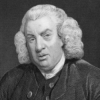
Samuel Johnson
Samuel Johnson, often referred to as Dr Johnson, was an English writer who made lasting contributions to English literature as a poet, essayist, moralist, literary critic, biographer, editor and lexicographer. Johnson was a devout Anglican and committed Tory, and has been described as "arguably the most distinguished man of letters in English history". He is also the subject of "the most famous single biographical work in the whole of literature," James Boswell's Life of Samuel Johnson...
NationalityEnglish
ProfessionNon-Fiction Author
Date of Birth18 September 1709
It is better that some should be unhappy than that none should be happy, which would be the case in a general state of equality.
It is easy to talk of sitting at home contented, when others are seeing or making shows. But not to have been where it is supposed, and seldom supposed falsely, that all would go if they could; to be able to say nothing when everyone is talking; to have no opinion when everyone is judging; to hear exclamations of rapture without power to depress; to listen to falsehoods without right to contradict, is, after all, a state of temporary inferiority, in which the mind is rather hardened by stubbornness, than supported by fortitude. If the world be worth winning let us enjoy it, if it is to be despised let us despise it by conviction. But the world is not to be despised but as it is compared with something better.
Hides from himself his state, and shuns to know That life protracted is protracted woe.
Human life is everywhere a state in which much is to be endured, and little to be enjoyed.
The really happy woman is the one who can enjoy the scenery when she has to take a detour. Happiness is not a state to arrive at, but rather a manner of traveling.
Adversity leads us to think properly of our state, and so is most beneficial to us.
The present is never a happy state to any human being.
Good-humor is a state between gayety and unconcern,--the act or emanation of a mind at leisure to regard the gratification of another.
Every state of society is as luxurious as it can be. Men always take the best they can get.
Our brightest blazes of gladness are commonly kindled by unexpected sparks.
It is better to remain silent and be thought a fool, than open one's mouth and remove all doubt.
Man, unlike any other thing organic or inorganic in the universe, grows beyond his work, walks up the stairs of his concepts, emerges ahead of his accomplishments.
Knowledge always demands increase; it is like fire, which must first be kindled by some external agent, but will afterwards always propagate itself.
Whoever thinks of going to bed before twelve o clock is a scoundrel.