Saul Perlmutter
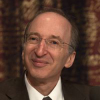
Saul Perlmutter
Saul Perlmutteris an American astrophysicist at the Lawrence Berkeley National Laboratory and a professor of physics at the University of California, Berkeley. He is a member of the American Academy of Arts & Sciences, and was elected a Fellow of the American Association for the Advancement of Science in 2003. He is also a member of the National Academy of Sciences. Perlmutter shared the 2006 Shaw Prize in Astronomy, the 2011 Nobel Prize in Physics, and the 2015 Breakthrough Prize...
NationalityAmerican
ProfessionScientist
CountryUnited States of America
From our point of view, the most exciting thing would be if we discovered something really fundamental in our understanding was just off a bit - and that now we have a chance to revisit it
You want your mind to be boggled. That is a pleasure in and of itself. And it's more a pleasure if it's boggled by something that you can then demonstrate is really, really true
I was one of those kids who always thought that we should know how the world works around us
Astronomers ought to be able to ask fundamental questions without accelerators
It's an unusual opportunity, a chance for so many people to share in the excitement and the fun of the fact that we may be on to hints as to what the Universe is made out of. I guess the whole point of a prize like this is to be able to get that out into the community
Your job as a scientist is to figure out how you're fooling yourself.
For almost a century, the Universe has been known to be expanding as a consequence of the Big Bang about 14 billion years ago. However, the discovery that this expansion is accelerating is astounding. If the expansion will continue to speed up, the Universe will end in ice.
This is the kind of discovery that resonates.
As a scientist, you feel a sense of team spirit for your country but you also have a sense of team spirit for the international community.
You might expect gravity would slow it down, but it's just expanding faster and faster
If you ask almost any of them, 'Do you stand behind your theory? Is this the answer?' I think almost everyone would say, 'No, no, no. I'm just trying to expand the range of possibilities.' We really don't know what's going on
If you're puzzled by what dark energy is, you're in good company.