Slavoj Zizek
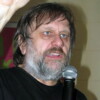
Slavoj Zizek
Slavoj Žižek; born 21 March 1949) is a Slovenian psychoanalytic philosopher, cultural critic, and Hegelian Marxist. He is a senior researcher at the Institute for Sociology and Philosophy at the University of Ljubljana, Global Distinguished Professor of German at New York University, and international director of the Birkbeck Institute for the Humanities of the University of London. His work is located at the intersection of a range of subjects, including continental philosophy, political theory, cultural studies, psychoanalysis, film criticism, and...
ProfessionPhilosopher
Date of Birth21 March 1949
There is an old joke about socialism as the synthesis of the highest achievements of the whole human history to date: from prehistoric societies it took primitivism; from the Ancient world it took slavery; from medieval society brutal domination; from capitalism exploitation; and from socialism the name.
True universalists are not those who preach global tolerance of differences and all-encompassing unity, but those who engage in a passionate struggle for the assertion of the Truth which compels them.
In Stalinism, everybody was potentially a victim in a totally contingent way.
[A]t the beginning of November 2001, there was a series of meetings between White House advisers and senior Hollywood executives with the aim of co-ordinating the war effort and establishing how Hollywood could help in the "war against terrorism" by getting the right ideological message across not only to Americans, but also to the Hollywood public around the globe the ultimate empirical proof that Hollywood does in fact function as an "ideological state apparatus.
You can be a fanatical millennialist religious mystic, and you are, in a certain way, not outside of ideology. Your position can be that of perfectly describing the data and nonetheless your point is ideological.
Come on. I don't have any problem violating my own insights in practice.
Undoubtedly [Beethoven's] music often verges on kitsch
Friends told me that the latest trend, at least in Europe, is public sex. They showed me some clips, and they're terrifying. A couple enters a streetcar, half-full, simply takes a seat, undresses, and starts to do it. You can see from surprised faces that it's not staged. It's pure working-class suburb. But what's fascinating is that the people all look, and then they politely ignore it. The message is that even if you're together in public with people, it still counts as private space.
What if the Soviet intervention was a blessing in disguise? It saved the myth that if the Soviets were not to intervene, there would have been some flowering authentic democratic socialism and so on. I'm a little bit more of a pessimist there. I think that the Soviets - it's a very sad lesson - by their intervention, saved the myth.
For me, ideology is defined only by how the coordinates of your meaningful experience of the world, and your place within society, relate to the basic tensions and antagonisms of social orders.
What Americans don't want to admit ... is that not only is there not a contradiction between state regulation and freedom, but in order for us to actually be free in our social interactions, there must be an extremely elaborated network of health, law, institutions, moral rules and so on.
A spectre is haunting Western academia (...), the spectre of the Cartesian subject.
Confucius was not so much a philsopher as a proto-ideologist: what interested him was not metaphysical Truths but rather a harmonious social order within which individuals could lead happy and ethical lives. He was the first to outline clearly what one is tempted to call the elementary scene of ideology, its zero-level, which consists in asserting the (nameless) authority of some substantial Tradition.
I secretly think reality exists so we can speculate about it.