Soren Kierkegaard
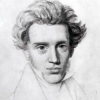
Soren Kierkegaard
Søren Aabye Kierkegaard; 5 May 1813 – 11 November 1855) was a Danish philosopher, theologian, poet, social critic and religious author who is widely considered to be the first existentialist philosopher. He wrote critical texts on organized religion, Christendom, morality, ethics, psychology, and the philosophy of religion, displaying a fondness for metaphor, irony and parables. Much of his philosophical work deals with the issues of how one lives as a "single individual", giving priority to concrete human reality over abstract thinking...
NationalityDanish
ProfessionPhilosopher
Date of Birth5 May 1813
CityCopenhagen, Denmark
CountryDenmark
Soren Kierkegaard quotes about
The self-assured believer is a greater sinner in the eyes of God than the troubled disbeliever.
Father in Heaven! When the thought of thee wakes in our hearts let it not awaken like a frightened bird that flies about in dismay, but like a child waking from its sleep with a heavenly smile.
It is quite true what Philosophy says: that Life must be understood backwards. But that makes one forget the other saying: that it must be lived—forwards. The more one ponders this, the more it comes to mean that life in the temporal existence never becomes quite intelligible, precisely because at no moment can I find complete quiet to take the backward- looking position.
A man who as a physical being is always turned toward the outside, thinking that his happiness lies outside him, finally turns inward and discovers that the source is within him.
People have an idea that the preacher is an actor on a stage and they are the critics, blaming or praising him. What they don't know is that they are the actors on the stage; he (the preacher) is merely the prompter standing in the wings, reminding them of their lost lines.
In the eyes of God, the infinite spirit, all the millions that have lived and now live do not make a crowd. He only sees each individual
People commonly travel the world over to see rivers and mountains, new stars, garish birds, freak fish, grotesque breeds of human; they fall into an animal stupor that gapes at existence and they think they have seen something.
The spiritual differs from the religious in being able to endure isolation. The rank of a spiritual person is proportionate to his strength for enduring isolation, whereas we religious people are constantly in need of 'the others,' the herd. We religious folks die, or despair, if we are not reassured by being in the assembly, of the same opinion as the congregation, and so on. But the Christianity of the New Testament is precisely related to the isolation of the spiritual man.
Compared with the person who is conscious of his despair, the despairing individual who is ignorant of his despair is simply a negativity further away from the truth and deliverance. . . . Yet ignorance is so far from breaking the despair or changing despair to nondespairing that it can in fact be the most dangerous form of despair. . . . An individual is furthest from being conscious of himself as spirit when he is ignorant of being in despair. But precisely this-not to be conscious of oneself as spirit-is despair, which is spiritlessness. . . .
Worldly wisdom thinks that love is a relationship between man and man. Christianity teaches that love is a relationship between man-God-man, that is, that God is the middle term.
Imagine hidden in a simpler exterior a secret receptacle wherein the most precious treasure is deposited - there is a spring which has to be pressed, but the spring is hidden, and the pressure must have a certain strength, so that an accidental pressure would not be sufficient. So likewise is the hope of eternity hidden in man's inmost parts, and affliction is the pressure. When it presses the hidden spring, and strongly enough, then the contents appear in all their glory.
A good decision is our will to do everything we can within our power. It means to serve God with all we've got, be it little or much. Every person can do that.
Philosophy is life's dry-nurse, who can take care of us - but not suckle us.
During the first period of a man's life the greatest danger is not to take the risk.