Thomas Aquinas
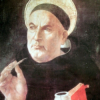
Thomas Aquinas
Thomas Aquinas, O.P., was an Italian Dominican friar, Catholic priest, and Doctor of the Church. He was an immensely influential philosopher, theologian, and jurist in the tradition of scholasticism, within which he is also known as the Doctor Angelicus and the Doctor Communis. The name Aquinas identifies his ancestral origins in the county of Aquino in present-day Lazio, where his family held land until 1137...
NationalityItalian
ProfessionTheologian
CountryItaly
beautiful mean add
Beauty adds to goodness a relation to the cognitive faculty: so that "good" means that which simply pleases the appetite; while the "beautiful" is something pleasant to apprehend.
mean two evil
It seems that God does not exist; because if one of two contraries be infinite, the other would be altogether destroyed. But the word "God" means that He is infinite goodness. If, therefore, God existed, there would be no evil discoverable; but there is evil in the world. Therefore God does not exist.
taken character mean
Evil denotes the lack of good. Not every absence of good is an evil, for absence may be taken either in a purely negative or in aprivative sense. Mere negation does not display the character of evil, otherwise nonexistents would be evil and moreover, a thing would be evil for not possessing the goodness of something else, which would mean that man is bad for not having the strength of a lion or the speed of a wild goat. But what is evil is privation; in this sense blindness means the privation of sight.
mean omission catholic
Three conditions are necessary for Penance: contrition, which is sorrow for sin, together with a purpose of amendment; confession of sins without any omission; and satisfaction by means of good works.
christian believe mean
Sacred Scripture, since it has no science above itself, can dispute with one who denies its principles only if the opponent admits some at least of the truths obtained through divine revelation; thus we can argue with heretics from texts in Holy Writ, and against those who deny one article of faith we can argue from another. If our opponent believes nothing of divine revelation, there is no longer any means of proving the articles of faith by reasoning, but only of answering his objections - if he has any - against faith.
mean two done
If a thing can be done adequately by means of one, it is superfluous to do it by means of several; for we observe that nature does not employ two instruments [if] one suffices.
american-comedian care certain common ordinance reason
Law is nothing other than a certain ordinance of reason for the common good, promulgated by the person who has the care of the community.
father greatness men
To restore man, who had been laid low by sin, to the heights of divine glory, the Word of the eternal Father, though containing all things within His immensity, willed to become small. This He did not by putting aside His greatness but by taking to Himself our littleness.
taught teach theology
Theology is taught by God, teaches God, and leads to God.
heart divine-help helping
We can open our hearts to God, but only with Divine help.
order tasks preacher
To teach in order to lead others to faith is the task of every preacher and of each believer.
pain fire doe
The fire of hell is called eternal, only because it never ends. Still, there is change in the pains of the lost...Hence in hell true eternity does not exist, but rather time.
doe saint bidding
Whatever was in the human nature of Christ was moved at the bidding of the divine will; yet it does not follow that in Christ there was no movement of the will proper to human nature, for the good wills of other saints are moved by God's will... For although the will cannot be inwardly moved by any creature, yet it can be moved inwardly by God.
stars thinking errors
Gods are called many by the error of some who worshipped many deities, thinking as they did the planets and other stars were gods, and also the separate parts of the world.