Thomas Carlyle
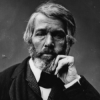
Thomas Carlyle
Thomas Carlylewas a Scottish philosopher, satirical writer, essayist, historian and teacher. Considered one of the most important social commentators of his time, he presented many lectures during his lifetime with certain acclaim in the Victorian era. One of those conferences resulted in his famous work On Heroes, Hero-Worship, and The Heroic in History where he explains that the key role in history lies in the actions of the "Great Man", claiming that "History is nothing but the biography of the...
NationalityScottish
ProfessionPhilosopher
Date of Birth4 December 1795
No man sees far, most see no farther than their noses.
Nay, in every epoch of the world, the great event, parent of all others, is it not the arrival of a Thinker in the world?
Statistics is a science which ought to be honourable, the basis of many most important sciences; but it is not to be carried on by steam, this science, any more than others are; a wise head is requisite for carrying it on.
A man perfects himself by working. Foul jungles are cleared away, fair seed-fields rise instead, and stately cities; and with the man himself first ceases to be a jungle, and foul unwholesome desert thereby. The man is now a man.
There is but one temple in this Universe: The Body. We speak to God whenever we lay our hands upon it.
The fine arts once divorcing themselves from truth are quite certain to fall mad, if they do not die.
Except by name, Jean Paul Friedrich Richter is little known out of Germany. The only thing connected with him, we think, that has reached this country is his saying,-imported by Madame de Staël, and thankfully pocketed by most newspaper critics,-"Providence has given to the French the empire of the land; to the English that of the sea; to the Germans that of-the air!" Richter: German humorist & prose writer.
No sooner does a great man depart, and leave his character as public property, than a crowd of little men rushes towards it. There they are gathered together, blinking up to it with such vision as they have, scanning it from afar, hovering round it this way and that, each cunningly endeavoring, by all arts, to catch some reflex of it in the little mirror of himself.
If those gentlemen would let me alone I should be much obliged to them. I would say, as Shakespeare would say... Sweet Friend, for Jesus sake forbear.
To the vulgar eye, few things are wonderful that are not distant
What, in the devil's name, is the use of respectability, with never so many gigs and silver spoons, if thou inwardly art the pitifulness of all men?
Statistics, one may hope, will improve gradually, and become good for something. Meanwhile, it is to be feared the crabbed satirist was partly right, as things go: "A judicious man," says he, "looks at Statistics, not to get knowledge, but to save himself from having ignorance foisted on him."
History, as it lies at the root of all science, is also the first distinct product of man's spiritual nature, his earliest expression of what may be called thought.
Science has done much for us; but it is a poor science that would hide from us the great deep sacred infinitude of Nescience, on which all science swims as a mere superficial film.