Thomas Carlyle
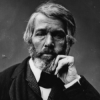
Thomas Carlyle
Thomas Carlylewas a Scottish philosopher, satirical writer, essayist, historian and teacher. Considered one of the most important social commentators of his time, he presented many lectures during his lifetime with certain acclaim in the Victorian era. One of those conferences resulted in his famous work On Heroes, Hero-Worship, and The Heroic in History where he explains that the key role in history lies in the actions of the "Great Man", claiming that "History is nothing but the biography of the...
NationalityScottish
ProfessionPhilosopher
Date of Birth4 December 1795
Does not every true man feel that he is himself made higher by doing reverence to what is really above him?
He that will not work according to his faculty, let him perish according to his necessity: there is no law juster than that.
... There is always hope in a man who actually and earnestly works.
A battle is a terrible conjugation of the verb to kill: I kill, thou killest, he kills, we kill, they kill, all kill.
I should say sincerity, a deep, great, genuine sincerity, is the first characteristic of all men in any way heroic.
There is something in man which your science cannot satisfy.
Parliament will train you to talk; and above all things to hear, with patience, unlimited quantities of foolish talk.
The world is an old woman, and mistakes any gilt farthing for a gold coin; whereby being often cheated, she will thenceforth trust nothing but the common copper.
Little other than a red tape Talking-machine, and unhappy Bag of Parliamentary Eloquence.
Rest is a fine medicine. Let your stomachs rest, ye dyspeptics; let your brain rest, you wearied and worried people of business; let your limbs rest, ye children of toil!
The Great Man's sincerity is of the kind he cannot speak of, is not conscious of: nay, I suppose, he is conscious rather of insincerity; for what man can walk accurately by the law of truth for one day? No, the Great Man does not boast himself sincere, far from that; perhaps does not ask himself if he is so: I would say rather, his sincerity does not depend on himself; he cannot help being sincere!
Cherish what is dearest while you have it near you, and wait not till it is far away. Blind and deaf that we are; oh, think, if thou yet love anybody living, wait not till death sweep down the paltry little dust clouds and dissonances of the moment, and all be made at last so mournfully clear and beautiful, when it is too late.
We were wise indeed, could we discern truly the signs of our own time; and by knowledge of its wants and advantages, wisely adjust our own position in it. Let us, instead of gazing idly into the obscure distance, look calmly around us, for a little, on the perplexed scene where we stand. Perhaps, on a more serious inspection, something of its perplexity will disappear, some of its distinctive characters and deeper tendencies more clearly reveal themselves; whereby our own relations to it, our own true aims and endeavors in it, may also become clearer.
In the true Literary Man there is thus ever, acknowledged or not by the world, a sacredness: he is the light of the world; the world's Priest; -- guiding it, like a sacred Pillar of Fire, in its dark pilgrimage through the waste of Time.