Thomas Carlyle
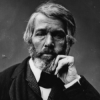
Thomas Carlyle
Thomas Carlylewas a Scottish philosopher, satirical writer, essayist, historian and teacher. Considered one of the most important social commentators of his time, he presented many lectures during his lifetime with certain acclaim in the Victorian era. One of those conferences resulted in his famous work On Heroes, Hero-Worship, and The Heroic in History where he explains that the key role in history lies in the actions of the "Great Man", claiming that "History is nothing but the biography of the...
NationalityScottish
ProfessionPhilosopher
Date of Birth4 December 1795
Thought once awakened does not again slumber; unfolds itself into a System of Thought; grows, in man after man, generation after generation, - till its full stature is reached, and such System of Thought can grow no farther, but must give place to another.
Silence is the element in which great things fashion themselves together; that at length they may emerge, full-formed and majestic, into the delight of life, which they are thenceforth to rule.
It were a real increase of human happiness, could all young men from the age of nineteen be covered under barrels, or rendered otherwise invisible; and there left to follow their lawful studies and callings, till they emerged, sadder and wiser, at the age of twenty-five.
I grow daily to honour facts more and more, and theory less and less. A fact, it seems to me, is a great thing; a sentence printed, if not by God, then at least by the Devil.
To reform a world, to reform a nation, no wise man will undertake; and all but foolish men know, that the only solid, though a far slower reformation, is what each begins and perfects on himself.
Man's unhappiness, as I construe, comes of his greatness; it is because there is an Infinite in him, which with all his cunning he cannot quite bury under the Finite.
Good breeding differs, if at all, from high breeding only as it gracefully remembers the rights of others, rather than gracefully insists on its own rights.
Everywhere the human soul stands between a hemisphere of light and another of darkness; on the confines of the two everlasting empires, necessity and free will.
True humor springs not more from the head than from the heart. It is not contempt; its essence is love. It issues not in laughter, but in still smiles, which lie far deeper.
Youth is to all the glad season of life; but often only by what it hopes, not by what it attains, or what it escapes.
When new turns of behavior cease to appear in the life of the individual, its behavior ceases to be intelligent.
Habit and imitation--there is nothing more perennial in us than these two. They are the source of all working, and all apprenticeship, of all practice, and all learning, in this world.
The healthy know not of their health, but only the sick: this is the physician's aphorism, and applicable in a far wider sense than he gives it.
The true epic of our times is not "Arm's and the Man," but "Tools and the Man"--an infinitely wider kind of epic.