Thomas Carlyle
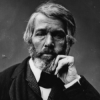
Thomas Carlyle
Thomas Carlylewas a Scottish philosopher, satirical writer, essayist, historian and teacher. Considered one of the most important social commentators of his time, he presented many lectures during his lifetime with certain acclaim in the Victorian era. One of those conferences resulted in his famous work On Heroes, Hero-Worship, and The Heroic in History where he explains that the key role in history lies in the actions of the "Great Man", claiming that "History is nothing but the biography of the...
NationalityScottish
ProfessionPhilosopher
Date of Birth4 December 1795
Permanence, perseverance and persistence in spite of all obstacles, discouragements, and impossibilities: It is this, that in all things distinguishes the strong soul from the weak.
A terrible, beetle-browed, mastiff-mouthed, yellow-skinned, broad-bottomed, grim-taciturn individual; with a pair of dull-cruel-looking black eyes, and as much Parliamentary intellect and silent-rage in him. . . as I have ever seen in any man.
The man without a purpose is like a ship without a rudder -- waif, a nothing, a no man. Have a purpose in life, and, having it, throw such strength of mind and muscle into your work as God has given you.
The first of all gospels is, that no lie lives forever.
The history of the world is but the biography of great men.
The heart always sees before than the head can see.
The greatest of all faults, I should say, is to be conscious of none.
The great law of culture - and surely this convention before us now is a great law of culture - is: let each person become all that he was created equal of being. That is what this convention will help to achieve.
The illimitable, silent, never-resting thing called Time, rolling, rushing on, swift, silent, like an all-embracing ocean-tide, on which we and all the universe swim like exhalations, like apparitions which are, and then are not: this is forever very literally a miracle; a thing to strike us dumb, for we have no word to speak about it.
What I loved in the man was his health, his unity with himself; all people and all things seemed to find their quite peaceable adjustment with him, not a proud domineering one, as after doubtful contest, but a spontaneous-looking peaceable, even humble one.
The true eye for talent presupposes the true reverence for it.
Silence is the eternal duty of man.
In our wide world there is but one altogether fatal personage, the dunce,--he that speaks irrationally, that sees not, and yet thinks he sees.
When I gaze into the stars, they look down upon me with pity from their serene and silent spaces, like eyes glistening with tears over the little lot of man. Thousands of generations, all as noisy as our own, have been swallowed up by time, and there remains no record of them any more. Yet Arcturus and Orion, Sirius and Pleiades, are still shining in their courses, clear and young, as when the shepherd first noted them in the plain of Shinar!