Thomas Carlyle
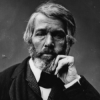
Thomas Carlyle
Thomas Carlylewas a Scottish philosopher, satirical writer, essayist, historian and teacher. Considered one of the most important social commentators of his time, he presented many lectures during his lifetime with certain acclaim in the Victorian era. One of those conferences resulted in his famous work On Heroes, Hero-Worship, and The Heroic in History where he explains that the key role in history lies in the actions of the "Great Man", claiming that "History is nothing but the biography of the...
NationalityScottish
ProfessionPhilosopher
Date of Birth4 December 1795
Quackery gives birth to nothing; gives death to all things.
See deep enough, and you see musically.
I know so little about any history. How little do I know even about the history of myself.
The times are very bad. Very well, you are there to make them better.
There must be a new world if there is to be any world at all!... These days of universal death must be days of universal new birth, if the ruin is not to be total and final! It is Time to make the dullest man consider; and ask himself, Whence he came? Whither he is bound?
After all manner of professors have done their best for us, the place we are to get knowledge is in books.
Hunger whets everything, especially Suspicion and Indignation.
Man makes circumstances, and spiritually as well as economically, is the artificer of his own fortune.
Just in the ratio knowledge increases, faith decreases.
In a symbol there is concealment and yet revelation: here therefore, by Silence and by Speech acting together, comes a double significance.
A very sea of thought; neither calm nor clear, if you will, yet wherein the toughest pearl-diver may dive to his utmost depth, and return not only with sea-wreck but with true orients.
Terror itself, when once grown transcendental, becomes a kind of courage; as frost sufficiently intense, according to the poet Milton, will burn.
Taste, if it mean anything but a paltry connoisseurship, must mean a general susceptibility to truth and nobleness, a sense to discern, and a heart to love and reverence all beauty, order, goodness, wheresoever, or in whatsoever forms and accompaniments they are to be seen. This surely implies, as its chief condition, not any given external rank or situation, but a finely-gifted mind, purified into harmony with itself, into keenness and justness of vision; above all, kindled into love and generous admiration.
Silence, the great Empire of Silence: higher than all stars; deeper than the Kingdom of Death! It alone is great; all else is small.