Thomas Jefferson
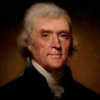
Thomas Jefferson
Thomas Jeffersonwas an American Founding Father who was the principal author of the Declaration of Independence. He was elected the second Vice President of the United States, serving under John Adams and in 1800 was elected the third President. Jefferson was a proponent of democracy, republicanism, and individual rights, which motivated American colonists to break from Great Britain and form a new nation. He produced formative documents and decisions at both the state and national level...
NationalityAmerican
ProfessionUS President
Date of Birth13 April 1743
CityShadwell, VA
CountryUnited States of America
A democracy is nothing more than mob rule, where fifty-one percent of the people may take away the rights of the other forty-nine.
Of liberty I would say that, in the whole plenitude of its extent, it is unobstructed action according to our will. But rightful liberty is unobstructed action according to our will within limits drawn around us by the equal rights of others. I do not add 'within the limits of the law,' because law is often but the tyrant's will, and always so when it violates the right of an individual.
We hold these truths to be sacred and undeniable; that all men are created equal and independent, that from that equal creation they derive rights inherent and inalienable, among which are the preservation of life, liberty, and the pursuit of happiness.
A bill of rights is what the people are entitled to against every government on earth, general or particular, and what no just government should refuse, or rest on inferences
The rights [to religious freedom] are of the natural rights of mankind, and ... if any act shall be ... passed to repeal [an act granting those rights] or to narrow its operation, such act will be an infringement of natural right.
Neither Pagan nor Mahamedan nor Jew ought to be excluded from the civil rights of the Commonwealth because of his religion. -quoting John Locke's argument.
Resolved ... that it would be a dangerous delusion were a confidence in the men of our choice to silence our fears for the safety of our rights: that confidence is everywhere the parent of despotism — free government is founded in jealousy, and not in confidence;
Mankind are more disposed to suffer, while evils are sufferable, than to right themselves by abolishing the forms to which they are accustomed.
The republican is the only form of government which is not eternally at open or secret war with the rights of mankind.
The States should be urged to concede to the General Government, with a saving of chartered rights, the exclusive power of establishing banks of discount for paper.
The declaration of rights [Bill of Rights] is, like all other human blessings, alloyed with some inconveniences and not accomplishing fully its object. But the good in this instance vastly outweighs the evil.
How to check these unconstitutional invasions of rights by the Federal judiciary? Not by impeachment in the first instance, but by a strong protestation of both houses of Congress that such and such doctrines advanced by the Supreme Court are contrary to the Constitution; and if afterwards they relapse into the same heresies, impeach and set the whole adrift. For what was the government divided into three branches, but that each should watch over the others and oppose their usurpations?
The opinions of men should not be the object of any government. Our civil rights are no more dependent on our religious beliefs than they are dependent upon our thoughts about geometry or physics!
The States should be watchful to note every material usurpation on their rights; to denounce them as they occur in the most peremptory terms; to protest against them as wrongs to which our present submission shall be considered, not as acknowledgments or precedents of rights, but as a temporary yielding to the lesser evil, until their accumulation shall overweigh that of separation.