Thomas Jefferson
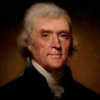
Thomas Jefferson
Thomas Jeffersonwas an American Founding Father who was the principal author of the Declaration of Independence. He was elected the second Vice President of the United States, serving under John Adams and in 1800 was elected the third President. Jefferson was a proponent of democracy, republicanism, and individual rights, which motivated American colonists to break from Great Britain and form a new nation. He produced formative documents and decisions at both the state and national level...
NationalityAmerican
ProfessionUS President
Date of Birth13 April 1743
CityShadwell, VA
CountryUnited States of America
we defer therefore till this time twelve month to avail ourselves of the instruction of that place, and particularly of your kindness in the two branches of Botany and Natural history to which we wish him particularly to apply.
I should . . . prefer swallowing one incomprehensibility rather than two. It requires one effort only to admit the single incomprehensibility of matter endowed with thought, and two to believe, first that of an existence called spirit, of which we have neither evidence nor idea, and then secondly how that spirit, which has neither extension nor solidity, can put material organs into motion.
So inscrutable is the arrangement of causes and consequences in this world, that a two-penny duty on tea, unjustly imposed in a sequestered part of it, changes the condition of all its inhabitants.
If by religion we are to understand sectarian dogmas, in which no two of them agree, then your exclamation on that hypothesis is just, "that this would be the best of worlds if there were no religion in it.
The happiness of society depends so much on preventing party spirit from infecting the common intercourse of life, that nothing should be spared to harmonize and amalgamate the two parties in social circles.
Never use one word when two will do.
When two parties make a compact, there results to each a power of compelling the other to execute it.
There are two amendments only which I am anxious for: 1. A bill of rights, which it is so much the interest of all to have that I conceive it must be yielded...2. The restoring of the principle of necessary rotation, particularly to the Senate and Presidency, but most of all to the last...
I feel a much greater interest in knowing what has passed two or three thousand years ago, than in what is now passing. I read nothing, therefore, but of the heroes of Troy, ... of Pompey and Caesar, and of Augustus too.
I think myself that we have more machinery of government than is necessary, too many parasites living on the labor of the industrious. Government big enough to supply everything you need is big enough to take everything you have ... The course of history shows that as a government grows, liberty decreases. The two enemies of the people are criminals and government, so let us tie the second down with the chains of the constitution so the second will not become the legalized version of the first.
All things here appear to me to trudge on in one and the same round: we rise in the morning that we may eat breakfast, dinner andsupper and to bed again that we may get up the next morning and do the same: so that you never saw two peas more alike than our yesterday and to-day.
But every state, says an inquisitor, has established some religion. No two, say I, have established the same. Is this a proof of the infallibility of establishments?
The mass of our citizens may be divided into two classes -- the laboring and the learned. The laboring will need the first grade of education to qualify them for their pursuits and duties; the learned will need it as a foundation for further acquirements.
What all agree upon is probably right; what no two agree in most probably is wrong.