Thomas Mann
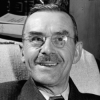
Thomas Mann
Paul Thomas Mannwas a German novelist, short story writer, social critic, philanthropist, essayist, and the 1929 Nobel Prize in Literature laureate. His highly symbolic and ironic epic novels and novellas are noted for their insight into the psychology of the artist and the intellectual. His analysis and critique of the European and German soul used modernized German and Biblical stories, as well as the ideas of Goethe, Nietzsche and Schopenhauer...
NationalityGerman
ProfessionNovelist
Date of Birth6 June 1875
CityLubeck, Germany
CountryGermany
It is remarkable how a man cannot summarize his thoughts in even the most general sort of way without betraying himself completely, without putting his whole self into it, quite unawares, presenting as if in allegory the basic themes and problems of his life.
In books we never find anything but ourselves. Strangely enough, that always gives us great pleasure, and we say the author is a genius.
Even in a personal sense, after all, art is an intensified life. By art one is more deeply satisfied and more rapidly used up. It engraves on the countenance of its servant the traces of imaginary and intellectual adventures, and even if he has outwardly existed in cloistral tranquility, it leads in the long term to overfastidiousness, over-refinement, nervous fatigue and overstimulation, such as can seldom result from a life of the most extravagant passions and pleasures.
Solitude produces originality, bold and astonishing beauty, poetry. But solitude also produces perverseness, the disproportianate, the absurd and the forbidden.
Nothing is more curious and awkward than the relationship of two people who only know each other with their eyes — who meet and observe each other daily, even hourly and who keep up the impression of disinterest either because of morals or because of a mental abnormality. Between them there is listlessness and pent-up curiosity, the hysteria of an unsatisfied, unnaturally suppressed need for communion and also a kind of tense respect. Because man loves and honors man as long as he is not able to judge him, and desire is a product of lacking knowledge.
Time has no divisions to mark its passage, there is never a thunder-storm or blare of trumpets to announce the beginning of a new month or year. Even when a new century begins it is only we mortals who ring bells and fire off pistols.
A lonely, quiet person has observations and experiences that are at once both more indistinct and more penetrating than those of one more gregarious; his thoughts are weightier, stranger, and never without a tinge of sadness. . . . Loneliness fosters that which is original, daringly and bewilderingly beautiful, poetic. But loneliness also fosters that which is perverse, incongruous, absurd, forbidden.
A harmful truth is better than a useful lie.
Isn't it grand, isn't it good, that language has only one word for everything we associate with love - from utter sanctity to the most fleshly lust? The result is perfect clarity in ambiguity, for love cannot be disembodied even in its most sanctified forms, nor is it without sanctity even at its most fleshly. Love is always simply itself, both as a subtle affirmation of life and as the highest passion; love is our sympathy with organic life.
Solitude gives birth to the original in us, to beauty unfamiliar and perilous - to poetry. But also, it gives birth to the opposite: to the perverse, the illicit, the absurd.
Laughter is a sunbeam of the soul.
War is only a cowardly escape from the problems of peace.
It is love, not reason, that is stronger than death.
If the years of youth are experienced slowly, while the later years of life hurtle past at an ever-increasing speed, it must be habit that causes it. We know full well that the insertion of new habits or the changing of old ones is the only way to preserve life, to renew our sense of time, to rejuvenate, intensify, and retard our experience of time—and thereby renew our sense of life itself. That is the reason for every change of scenery and air..