Thomas Paine
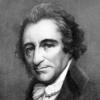
Thomas Paine
Thomas Painewas an English-American political activist, philosopher, political theorist, and revolutionary. One of the Founding Fathers of the United States, he authored the two most influential pamphlets at the start of the American Revolution, and he inspired the rebels in 1776 to declare independence from Britain. His ideas reflected Enlightenment-era rhetoric of transnational human rights. He has been called "a corsetmaker by trade, a journalist by profession, and a propagandist by inclination"...
NationalityEnglish
ProfessionPhilosopher
Date of Birth29 January 1736
CityThetford, England
Thomas Paine quotes about
Tis the business of little minds to shrink; but he whose heart is firm, and whose conscience approves his conduct, will pursue his principles unto death.
I love the man that can smile in trouble, that can gather strength from distress, and grow brave by reflection. 'Tis the business of little minds to shrink, but he whose heart is firm, and whose conscience approves his conduct, will pursue his principles unto death.
...the true greatness of a nation is founded on principles of humanity.
Those words, temperate and moderate, are words either of political cowardice, or of cunning, or seduction. A thing, moderately good is not so good as it ought to be. Moderation in temper, is always a virtue; but moderation in principle, is a species of vice.
...the individuals themselves, each in his own personal and sovereign right, entered into a compact with each other to produce a government: and this is the only mode in which governments have a right to arise, and the only principle on which they have a right to exist.
Before anything can be reasoned upon to a conclusion, certain facts, principles, or data, to reason from, must be established, admitted, or denied.
Every science has for its basis a system of principles as fixed and unalterable as those by which the universe is regulated and governed. Man cannot make principles; he can only discover them.
The danger to which the success of revolutions is most exposed, is that of attempting them before the principles on which they proceed, and the advantages to result from them, are sufficiently seen and understood.
The Grecians and Romans were strongly possessed of the spirit of liberty but not the principle, for at the time they were determined not to be slaves themselves, they employed their power to enslave the rest of mankind.
Society in every state is a blessing, but government, even in its best stage, is but a necessary evil; in its worst state an intolerable one.
A thing moderately good is not so good as it ought to be. Moderation in temper is always a virtue; but moderation in principle is always a vice.
Those who want to reap the benefits of this great nation must bear the fatigue of supporting it.
He that would make his own liberty secure, must guard even his enemy from oppression; for if he violates this duty, he establishes a precedent that will reach to himself.
We have it in our power to begin the world over again.