William James
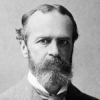
William James
William Jameswas an American philosopher and psychologist who was also trained as a physician. The first educator to offer a psychology course in the United States, James was one of the leading thinkers of the late nineteenth century and is believed by many to be one of the most influential philosophers the United States has ever produced, while others have labelled him the "Father of American psychology". Along with Charles Sanders Peirce and John Dewey, he is considered to be...
NationalityAmerican
ProfessionPhilosopher
Date of Birth11 January 1842
CityNew York City, NY
CountryUnited States of America
Romeo wants Juliet as the filings want the magnet; and if no obstacles intervene he moves towards her by as straight a line as they. But Romeo and Juliet, if a wall be built between them, do not remain idiotically pressing their faces against its opposite sides like the magnet and the filings with the card. Romeo soon finds a circuitous way, by scaling the wall or otherwise, of touching Juliet's lips directly. With the filings the path is fixed; whether it reaches the end depends on accidents. With the lover it is the end which is fixed, the path may be modified indefinitely.
... if we take the universe of 'fitting,' countless coats 'fit' backs, and countless boots 'fit' feet, on which they are not practically fitted; countless stones 'fit' gaps in walls into which no one seeks to fit them actually. In the same way countless opinions 'fit' realities, and countless truths are valid, tho no thinker ever thinks them.
Our intelligence cannot wall itself up alive, like a pupa in a chrysalis. It must at any cost keep on speaking terms with the universe that engendered it.
Our civilization is founded on the shambles, and every individual existence goes out in a lonely spasm of helpless agony. If you protest, my friend, wait till you arrive there yourself!
When you have to make a choice and don't make it, that in itself is a choice.
The exclusive worship of the bitch-goddess Success is our national disease.
Action may not bring happiness but there is no happiness without action.
Many people think they are thinking when they are merely rearranging their prejudices.
Action seems to follow feeling, but really action and feeling go together; and by regulating the action, which is under the more direct control of the will, we can indirectly regulate the feeling, which is not.
Be willing to have it so. Acceptance of what has happened is the first step to overcoming the consequences of any misfortune.
Thus the sovereign voluntary path to cheerfulness, if cheerfulness be lost, is to sit up cheerfully and to act and speak as if cheerfulness were already there.
The deepest principle of human nature is the craving to be appreciated.
Whenever two people meet there are really six people present. There is each man as he sees himself, each man as the other person sees him, and each man as he really is.
The greatest weapon against stress is our ability to choose one thought over another.