Aleksandr Solzhenitsyn
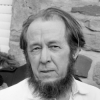
Aleksandr Solzhenitsyn
Aleksandr Isayevich Solzhenitsyn was a Russian novelist, historian, and short story writer. He was an outspoken critic of the Soviet Union and its totalitarianism and helped to raise global awareness of its Gulag forced labor camp system. He was allowed to publish only one work in the Soviet Union, One Day in the Life of Ivan Denisovich, in the periodical Novy Mir. After this he had to publish in the West, most notably Cancer Ward, August 1914, and The Gulag...
NationalityRussian
ProfessionNovelist
Date of Birth11 December 1918
CityKislovodsk, Russia
CountryRussian Federation
Aleksandr Solzhenitsyn quotes about
There is something predetermined in the mutual attraction between Germany and Russia. Otherwise, this attraction would not have survived two ghastly World Wars.
I was always optimistic. And I held to and was guided by my views.
I have always had that inner drive, since my birth. And I have always devoted myself gladly to work - to work and to the struggle.
Bless you, prison, for having been in my life!
Let us not forget that violence does not live alone and is not capable of living alone: it is necessarily interwoven with falsehood. Between them lies the most intimate, the deepest of natural bonds. Violence finds its only refuge in falsehood, falsehood its only support in violence. Any man who has once acclaimed violence as his method must inexorably choose falsehood as his principle.
Even the most rational approach to ethics is defenseless if there isn't the will to do what is right.
One word of truth outweighs the whole world.
Happiness doesn't depend on the actual number of blessings we manage to scratch from life, only our attitude towards them....
In our village, folks say God crumbles up the old moon into stars.
The one good thing about repeating your mistakes is that you know when to cringe
Such as it is, the press has become the greatest power within the Western World, more powerful than the legislature, the executive and judiciary. One would like to ask; by whom has it been elected and to whom is it responsible?
With such global events looming over us like mountains, nay, like entire mountain ranges, it may seem incongruous and inappropriate to recall that the primary key to our being or non-being resides in each individual human heart, in the heart's preference for specific good or evil. Yet this remains true even today, and it is, in fact, the most reliable key we have. The social theories that promised so much have demonstrated their bankruptcy, leaving us at a dead end.
In the camp, this meant committing my verse-many thousands of lines-to memory. To help me with this I improvised decimal counting beads and, in transit prisons, broke up matchsticks and used the fragments as tallies. As I approached the end of my sentences I grew more confident of my powers of memory, and began writing down and memorizing prose-dialogue at first, but then, bit by bit, whole densely written passages. My memory found room for them! It worked. But more and more of my time-in the end as much as one week every month-went into the regular repetition of all I had memorized.
If we live in a state of constant fear, can we remain human?