Aleksandr Solzhenitsyn
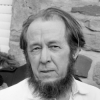
Aleksandr Solzhenitsyn
Aleksandr Isayevich Solzhenitsyn was a Russian novelist, historian, and short story writer. He was an outspoken critic of the Soviet Union and its totalitarianism and helped to raise global awareness of its Gulag forced labor camp system. He was allowed to publish only one work in the Soviet Union, One Day in the Life of Ivan Denisovich, in the periodical Novy Mir. After this he had to publish in the West, most notably Cancer Ward, August 1914, and The Gulag...
NationalityRussian
ProfessionNovelist
Date of Birth11 December 1918
CityKislovodsk, Russia
CountryRussian Federation
Aleksandr Solzhenitsyn quotes about
When one is already on the edge of the grave, why not resist?
A poet cannot be a Party member ... without paying the price.
There is eternal simplicity to a solution once it has been discovered!
Was it Gorky who said: "If your children are no better than you are, you have fathered in vain, indeed you have lived in vain.
And keep as few things as possible, so that you don't have to fear for them. Give them up without a struggle-because otherwise the humiliation will poison your heart. They will take them away from you in a fight, and trying to hold onto your property will only leave you with a bloodied mouth ... But by owning things and trembling about their fate aren't you forfeiting the rare opportunity of observing and understanding?
Every act of perception has an emotional coloring.
It's quite enough to show a well-beaten dog the whip.
Scientific research? Only when not at the cost of ethics-and first of all, those of the researchers themselves.
... a man can safely sacrifice a great deal as long as he clings to the essential.
But nothing is all black in nature.
It is a brave man who is the first to sit down during a standing ovation.
There are defendants whom the judges are afraid of.
A leader should not be a man who arbitrarily imported his own ideas but the essential focal point for a group of people who trusted one another and worked for a common aim.
I refuse to see literature as amusement, as a game. I think that you ought not to approach literature without a moral responsibility for every word you write.