Angela Davis
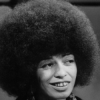
Angela Davis
Angela Yvonne Davisis an American political activist, academic scholar, and author. She emerged as a prominent counterculture activist and radical in the 1960s as a leader of the Communist Party USA, and had close relations with the Black Panther Party through her involvement in the Civil Rights Movement. Her interests include prisoner rights; she founded Critical Resistance, an organization working to abolish the prison-industrial complex. She was a professorat the University of California, Santa Cruz. in its History of Consciousness...
ProfessionTeacher
Date of Birth26 January 1944
CityBirmingham, AL
First of all, I didn't suggest that we should simply get rid of all prisons.
I'm suggesting that we abolish the social function of prisons.
I'm involved in the work around prison rights in general.
Poor people, people of color - especially are much more likely to be found in prison than in institutions of higher education.
Prisons do not disappear problems, they disappear human beings…
Jails and prisons are designed to break human beings, to convert the population into specimens in a zoo - obedient to our keepers, but dangerous to each other.
It's true that it's within the realm of cultural politics that young people tend to work through political issues, which I think is good, although it's not going to solve the problems
I think it is important to acknowledge the extent to which the black middle class tends to rely on a kind of imagined struggle that gets projected into commodities like kente cloth for example on the one hand and images like the Million Man March.
Not only the brothers on the street but the middle class brothers are also identifying with the gangster rappers because of the extent to which this music circulates. It becomes possible for the - not only the young middle class men, but it becomes possible for young middle class white men and young men of other racial communities to identify with the misogyny of gangster rap.
I think that the response to the OJ Simpson trial was based on a kind of sensibility that emerged out of the many campaigns to defend black communities against police violence.
Kids these days are kind of going back to Tupac and Snoop Doggy Dogg as examples of people that stand for something.
I'm thinking about some developments say in the 80s when the anti-apartheid movement began to claim more support and strength within the US. Black trade unionists played a really important role in developing this US anti-apartheid movement.
As soon as my trial was over, we tried to use the energy that had developed around my case to create another organization, which we called the National Alliance against Racist and Political Repression.
Yes, I think it's really important to acknowledge that Dr. King, precisely at the moment of his assassination, was re-conceptualizing the civil rights movement and moving toward a sort of coalitional relationship with the trade union movement.