Aristotle
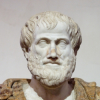
Aristotle
Aristotle was a Greek philosopher and scientist born in the city of Stagira, Chalkidice, on the northern periphery of Classical Greece. His father, Nicomachus, died when Aristotle was a child, whereafter Proxenus of Atarneus became his guardian. At eighteen, he joined Plato's Academy in Athens and remained there until the age of thirty-seven. His writings cover many subjects – including physics, biology, zoology, metaphysics, logic, ethics, aesthetics, poetry, theater, music, rhetoric, linguistics, politics and government – and constitute the first comprehensive system...
NationalityGreek
ProfessionPhilosopher
Happiness, then, is co-extensive with contemplation, and the more people contemplate, the happier they are; not incidentally, but in virtue of their contemplation, because it is in itself precious. Thus happiness is a form of contemplation.
For contemplation is both the highest form of activity (since the intellect is the highest thing in us, and the objects that it apprehends are the highest things that can be known), and also it is the most continuous, because we are more capable of continuous contemplation than we are of any practical activity.
...virtue is not merely a state in conformity with the right principle, but one that implies the right principle; and the right principle in moral conduct is prudence.
It [Justice] is complete virtue in the fullest sense, because it is the active exercise of complete virtue; and it is complete because its possessor can exercise it in relation to another person, and not only by himself.
So virtue is a purposive disposition, lying in a mean that is relative to us and determined by a rational principle, and by that which a prudent man would use to determine it. It is a mean between two kinds of vice, one of excess and the other of deficiency...
... the good for man is an activity of the soul in accordance with virtue, or if there are more kinds of virtue than one, in accordance with the best and most perfect kind.
Happiness, then, is found to be something perfect and self-sufficient, being the end to which our actions are directed.
Earthworms are the intenstines of the soil.
You are what you repeatedly do
The Good of man is the active exercise of his soul's faculties in conformity with excellence or virtue, or if there be several human excellences or virtues, in conformity with the best and most perfect among them.
for we are inquiring not in order to know what virtue is, but in order to become good, since otherwise our inquiry would have been of no use
Happiness is the highest good
Modesty is hardly to be described as a virtue. It is a feeling rather than a disposition. It is a kind of fear of falling into disrepute.
Humility is a flower which does not grow in everyone's garden.