Aristotle
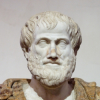
Aristotle
Aristotle was a Greek philosopher and scientist born in the city of Stagira, Chalkidice, on the northern periphery of Classical Greece. His father, Nicomachus, died when Aristotle was a child, whereafter Proxenus of Atarneus became his guardian. At eighteen, he joined Plato's Academy in Athens and remained there until the age of thirty-seven. His writings cover many subjects – including physics, biology, zoology, metaphysics, logic, ethics, aesthetics, poetry, theater, music, rhetoric, linguistics, politics and government – and constitute the first comprehensive system...
NationalityGreek
ProfessionPhilosopher
Justice is the loveliest and health is the best. but the sweetest to obtain is the heart's desire.
But since there is but one aim for the entire state, it follows that education must be one and the same for all, and that the responsibility for it must be a public one, not the private affair which it now is, each man looking after his own children and teaching them privately whatever private curriculum he thinks they ought to study.
...happiness is an activity and a complete utilization of virtue, not conditionally but absolutely.
A state is an association of similar persons whose aim is the best life possible. What is best is happiness, and to be happy is an active exercise of virtue and a complete employment of it.
So it is clear that the search for what is just is a search for the mean; for the law is the mean.
Justice therefore demands that no one should do more ruling than being ruled, but that all should have their turn.
So we must lay it down that the association which is a state exists not for the purpose of living together but for the sake of noble actions. Those who contribute most to this kind of association are for that very reason entitled to a larger share in the state than those who, though they may be equal or even superior in free birth and in family, are inferior in the virtue that belongs to a citizen. Similarly they are entitled to a larger share than those who are superior in riches but inferior in virtue.
But obviously a state which becomes progressively more and more of a unity will cease to be a state at all. Plurality of numbers is natural in a state; and the farther it moves away from plurality towards unity, the less of a state it becomes and the more a household, and the household in turn an individual.
If then nature makes nothing without some end in view, nothing to no purpose, it must be that nature has made all of them for the sake of man.
Money is a guarantee that we may have what we want in the future. Though we need nothing at the moment it insures the possibility of satisfying a new desire when it arises.
There is a cropping-time in the races of men, as in the fruits of the field; and sometimes, if the stock be good, there springs up for a time a succession of splendid men; and then comes a period of barrenness.
Fortune favours the bold.
All men naturally desire knowledge. An indication of this is our esteem for the senses; for apart from their use we esteem them for their own sake, and most of all the sense of sight. Not only with a view to action, but even when no action is contemplated, we prefer sight, generally speaking, to all the other senses. The reason of this is that of all the senses sight best helps us to know things, and reveals many distinctions.
All teaching and all intellectual learning come about from already existing knowledge.