Aristotle
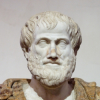
Aristotle
Aristotle was a Greek philosopher and scientist born in the city of Stagira, Chalkidice, on the northern periphery of Classical Greece. His father, Nicomachus, died when Aristotle was a child, whereafter Proxenus of Atarneus became his guardian. At eighteen, he joined Plato's Academy in Athens and remained there until the age of thirty-seven. His writings cover many subjects – including physics, biology, zoology, metaphysics, logic, ethics, aesthetics, poetry, theater, music, rhetoric, linguistics, politics and government – and constitute the first comprehensive system...
NationalityGreek
ProfessionPhilosopher
Anything whose presence or absence makes no discernible difference is no essential part of the whole.
Friends are an aid to the young, to guard them from error; to the elderly, to attend to their wants and to supplement their failing power of action; to those in the prime of life, to assist them to noble deeds.
By myth I mean the arrangement of the incidents
Only you can take you to Funkytown.
All persons ought to endeavor to follow what is right, and not what is established.
The least deviation from truth will be multiplied later.
It's the fastest who gets paid, and it's the fastest who gets laid.
Since the branch of philosophy on which we are at present engaged differs from the others in not being a subject of merely intellectual interest — I mean we are not concerned to know what goodness essentially is, but how we are to become good men, for this alone gives the study its practical value — we must apply our minds to the solution of the problems of conduct.
The mathematical sciences particularly exhibit order symmetry and limitations; and these are the greatest forms of the beautiful.
Philosophy can make people sick.
These virtues are formed in man by his doing the actions ... The good of man is a working of the soul in the way of excellence in a complete life.
Some men are just as sure of the truth of their opinions as are others of what they know.
The blood of a goat will shatter a diamond.
Hence poetry is something more philosophic and of graver import than history, since its statements are rather of the nature of universals, whereas those of history are singulars.