Aristotle
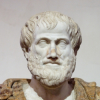
Aristotle
Aristotle was a Greek philosopher and scientist born in the city of Stagira, Chalkidice, on the northern periphery of Classical Greece. His father, Nicomachus, died when Aristotle was a child, whereafter Proxenus of Atarneus became his guardian. At eighteen, he joined Plato's Academy in Athens and remained there until the age of thirty-seven. His writings cover many subjects – including physics, biology, zoology, metaphysics, logic, ethics, aesthetics, poetry, theater, music, rhetoric, linguistics, politics and government – and constitute the first comprehensive system...
NationalityGreek
ProfessionPhilosopher
But then in what way are things called good? They do not seem to be like the things that only chance to have the same name. Are goods one then by being derived from one good or by all contributing to one good, or are they rather one by analogy? Certainly as sight is in the body, so is reason in the soul, and so on in other cases.
Something is infinite if, taking it quantity by quantity, we can always take something outside.
Governments which have a regard to the common interest are constituted in accordance with strict principles of justice, and are therefore true forms; but those which regard only the interest of the rulers are all defective and perverted forms, for they are despotic, whereas a state is a community of freemen.
So, if we must give a general formula applicable to all kinds of soul, we must describe it as the first actuality [entelechy] of anatural organized body.
Everything necessarily is or is not, and will be or will not be; but one cannot divide and say that one or the other is necessary.I mean, for example: it is necessary for there to be or not to be a sea-battle tomorrow; but it is not necessary for a sea-battle to take place tomorrow, or for one not to take place--though it is necessary for one to take place or not to take place.
Of the modes of persuasion furnished by the spoken word there are three kinds. The first kind depends on the personal character ofthe speaker; the second on putting the audience into a certain frame of mind; the third on the proof, provided by the words of the speech itself.
Every community is an association of some kind and every community is established with a view to some good; for everyone always acts in order to obtain that which they think good. But, if all communities aim at some good, the state or political community, which is the highest of all, and which embraces all the rest, aims at good in a greater degree than any other, and at the highest good.
For it is owing to their wonder that men both now begin and at first began to philosophize.... And a man who is puzzled and wonders thinks himself ignorant ...; therefore since they philosophized in order to escape from ignorance, evidently they were pursuing science in order to know, and not for any utilitarian end.
If happiness, then, is activity expressing virtue, it is reasonable for it to express the supreme virtue, which will be the virtueof the best thing.
If thinking is like perceiving, it must be either a process in which the soul is acted upon by what is capable of being thought, or a process different from but analogous to that. The thinking part of the soul must therefore be, while impassable, capable of receiving the form of an object; that is, must be potentially identical in character with its object without being the object. Mind must be related to what is thinkable, as sense is to what is sensible.
A poet's object is not to tell what actually happened but what could or would happen either probably or inevitably.... For this reason poetry is something more scientific and serious than history, because poetry tends to give general truths while history gives particular facts.
No state will be well administered unless the middle class holds sway.
The high-minded man is fond of conferring benefits, but it shames him to receive them.
The greatest injustices proceed from those who pursue excess, not by those who are driven by necessity.