Aristotle
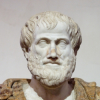
Aristotle
Aristotle was a Greek philosopher and scientist born in the city of Stagira, Chalkidice, on the northern periphery of Classical Greece. His father, Nicomachus, died when Aristotle was a child, whereafter Proxenus of Atarneus became his guardian. At eighteen, he joined Plato's Academy in Athens and remained there until the age of thirty-seven. His writings cover many subjects – including physics, biology, zoology, metaphysics, logic, ethics, aesthetics, poetry, theater, music, rhetoric, linguistics, politics and government – and constitute the first comprehensive system...
NationalityGreek
ProfessionPhilosopher
Madness is badness of spirit, when one seeks profit from all sources.
The first principle of all action is leisure.
The misanthrope, as an essentially solitary man, is not a man at all: he must be a beast or a god...
Soul and body, I suggest react sympathetically upon each other. A change in the state of the soul produces a change in the shape of the body and conversely, a change in the shape of the body produces a change in the state of the soul.
Man first begins to philosophize when the necessities of life are supplied.
Rhetoric may be defined as the faculty of observing in any given case the available means of persuasion.
For good is simple, evil manifold.
Wicked men obey out of fear. good men, out of love
A man's happiness consists in the free exercise of his highest faculties.
The continuum is that which is divisible into indivisibles that are infinitely divisible.
Fine friendship requires duration rather than fitful intensity.
Aristocracy is that form of government in which education and discipline are qualifications for suffrage and office holding.
Finally, if nothing can be truly asserted, even the following claim would be false, the claim that there is no true assertion.
In part, art completes what nature cannot elaborate; and in part it imitates nature.