Aristotle
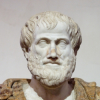
Aristotle
Aristotle was a Greek philosopher and scientist born in the city of Stagira, Chalkidice, on the northern periphery of Classical Greece. His father, Nicomachus, died when Aristotle was a child, whereafter Proxenus of Atarneus became his guardian. At eighteen, he joined Plato's Academy in Athens and remained there until the age of thirty-seven. His writings cover many subjects – including physics, biology, zoology, metaphysics, logic, ethics, aesthetics, poetry, theater, music, rhetoric, linguistics, politics and government – and constitute the first comprehensive system...
NationalityGreek
ProfessionPhilosopher
Laws, when good, should be supreme; and that the magistrate or magistrates should regulate those matters only on which the laws are unable to speak with precision owing to the difficulty of any general principle embracing all particulars.
Even if you must have regard to wealth, in order to secure leisure, yet it is surely a bad thing that the greatest offices, such as those of kings and generals, should be bought. The law which allows this abuse makes wealth of more account than virtue, and the whole state becomes avaricious.
When we look at the matter from another point of view, great caution would seem to be required. For the habit of lightly changing the laws is an evil, and, when the advantage is small, some errors both of lawgivers and rulers had better be left; the citizen will not gain so much by making the change as he will lose by the habit of disobedience.
Also our fellow competitors, who are indeed the people just mentioned - we do not compete with men who lived a hundred centuries ago, or those yet not born, or the dead, or those who dwell near the Pillars of Hercules, or those whom, in our opinion or that of others, we take to be far below us or far above us. So too we compete with those who follow the same ends as ourselves; we compete with our rivals in sport or in love, and generally with those who are after the same things; and it is therefore these whom we are bound to envy beyond all others. Hence the saying:
Nor need it cause surprise that things disagreeable to the good man should seem pleasant to some men; for mankind is liable to many corruptions and diseases, and the things in question are not really pleasant, but only pleasant to these particular persons, who are in a condition to think them so.
In the human species at all events there is a great diversity of pleasures. The same things delight some men and annoy others, and things painful and disgusting to some are pleasant and attractive to others.
All men, or most men, wish what is noble but choose what is profitable; and while it is noble to render a service not with an eye to receiving one in return, it is profitable to receive one. One ought therefore, if one can, to return the equivalent of services received, and to do so willingly; for one ought not to make a man one's friend if one is unwilling to return his favors.
As the pleasures of the body are the ones which we most often meet with, and as all men are capable of these, these have usurped the family title; and some men think these are the only pleasures that exist, because they are the only ones which they know.
Both Self-restraint and Unrestraint are a matter of extremes as compared with the character of the mass of mankind; the restrained man shows more and the unrestrained man less steadfastness than most men are capable of.
All are agreed that the various moral qualities are in a sense bestowed by nature: we are just, and capable of temperance, and brave, and possessed of the other virtues from the moment of our birth. But nevertheless we expect to find that true goodness is something different, and that the virtues in the true sense come to belong to us in another way. For even children and wild animals possess the natural dispositions, yet without Intelligence these may manifestly be harmful.
Man, as an originator of action, is a union of desire and intellect.
Those who merely possess the goods of fortune may be haughty and insolent; . . . they try to imitate the great-souled man without being really like him, and only copy him in what they can, reproducing his contempt for others but not his virtuous conduct. For the great-souled man is justified in despising other people - his estimates are correct; but most proud men have no good ground for their pride.
[Meanness] is more ingrained in man's nature than Prodigality; the mass of mankind are avaricious rather than open-handed.
No one chooses what does not rest with himself, but only what he thinks can be attained by his own act.