Aristotle
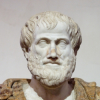
Aristotle
Aristotle was a Greek philosopher and scientist born in the city of Stagira, Chalkidice, on the northern periphery of Classical Greece. His father, Nicomachus, died when Aristotle was a child, whereafter Proxenus of Atarneus became his guardian. At eighteen, he joined Plato's Academy in Athens and remained there until the age of thirty-seven. His writings cover many subjects – including physics, biology, zoology, metaphysics, logic, ethics, aesthetics, poetry, theater, music, rhetoric, linguistics, politics and government – and constitute the first comprehensive system...
NationalityGreek
ProfessionPhilosopher
Whereas happiness is the highest good, being a realization and perfect practice of virtue, which some can attain, while others have little or none of it, the various qualities of men are clearly the reason why there are various kinds of states and many forms of government; for different men seek after happiness in different ways and by different means, and so make for themselves different modes of life and forms of government.
Most men appear to think that the art of despotic government is statesmanship, and what men affirm to be unjust and inexpedient in their own case they are not ashamed of practicing towards others; they demand just rule for themselves, but where other men are concerned they care nothing about it. Such behavior is irrational; unless the one party is, and the other is not, born to serve, in which case men have a right to command, not indeed all their fellows, but only those who are intended to be subjects; just as we ought not to hunt mankind, whether for food or sacrifice . .
Every man should be responsible to others, nor should any one be allowed to do just as he pleases; for where absolute freedom is allowed, there is nothing to restrain the evil which is inherent in every man.
Although it may be difficult in theory to know what is just and equal, the practical difficulty of inducing those to forbear who can, if they like, encroach, is far greater, for the weaker are always asking for equality and justice, but the stronger care for none of these things.
The avarice of mankind is insatiable; at one time two obols was pay enough; but now, when this sum has become customary, men always want more and more without end.
Again, the male is by nature superior, and the female inferior; and the one rules, and the other is ruled; this principle, of necessity, extends to all mankind.
A good man may make the best even of poverty and disease, and the other ills of life; but he can only attain happiness under the opposite conditions
It must not be supposed that happiness will demand many or great possessions; for self-sufficiency does not depend on excessive abundance, nor does moral conduct, and it is possible to perform noble deeds even without being ruler of land and sea: one can do virtuous acts with quite moderate resources. This may be clearly observed in experience: private citizens do not seem to be less but more given to doing virtuous actions than princes and potentates. It is sufficient then if moderate resources are forthcoming; for a life of virtuous activity will be essentially a happy life.
The activity of God, which is transcendent in blessedness, is the activity of contemplation; and therefore among human activities that which is most akin to the divine activity of contemplation will be the greatest source of happiness.
It is the activity of the intellect that constitutes complete human happiness - provided it be granted a complete span of life, for nothing that belongs to happiness can be incomplete.
Happiness is essentially perfect; so that the happy man requires in addition the goods of the body, external goods and the gifts of fortune, in order that his activity may not be impeded through lack of them.
Happiness is a certain activity of soul in conformity with perfect goodness
Happiness is a thing honored and perfect. This seems to be borne out by the fact that it is a first principle or starting-point, since all other things that all men do are done for its sake; and that which is the first principle and cause of things good we agree to be something honorable and divine.
No one praises happiness as one praises justice, but we call it a 'blessing,' deeming it something higher and more divine than things we praise.