Benoit Mandelbrot
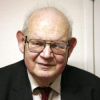
Benoit Mandelbrot
Benoit B. Mandelbrot was a Polish-born, French and American mathematician with broad interests in the practical sciences, especially regarding what he labeled as "the art of roughness" of physical phenomena and "the uncontrolled element in life." He referred to himself as a "fractalist". He is recognized for his contribution to the field of fractal geometry, which included coining the word "fractal'", as well as developing a theory of "roughness and self-similarity" in nature...
NationalityFrench
ProfessionMathematician
Date of Birth20 November 1924
CountryFrance
I've been a professor of mathematics at Harvard and at Yale. At Yale for a long time. But I'm not a mathematician only. I'm a professor of physics, of economics, a long list. Each element of this list is normal. The combination of these elements is very rare at best.
The beauty of what I happened by extraordinary chance to put together is that nobody would have believed that this is possible, and certainly I didn't expect that it was possible. I just moved from step to step to step.
It was astonishing when at one point, I got the idea of how to make artifical clouds with a collaborator, we had pictures made which were theoretically completely artificial pictures based upon that one very simple idea. And this picture everybody views as being clouds.
The theory of chaos and theory of fractals are separate, but have very strong intersections. That is one part of chaos theory is geometrically expressed by fractal shapes.
In mathematics and science definition are simple, but bare-bones. Until you get to a problem which you understand it takes hundreds and hundreds of pages and years and years of learning.
I had many books and I had dreams of all kinds. Dreams in which were in a certain sense, how to say, easy to make because the near future was always extremely threatening.
I didn't feel comfortable at first with pure mathematics, or as a professor of pure mathematics. I wanted to do a little bit of everything and explore the world.
Everything is roughness, except for the circles. How many circles are there in nature? Very, very few. The straight lines. Very shapes are very, very smooth. But geometry had laid them aside because they were too complicated.
When people ask me what's my field? I say, on one hand, a fractalist. Perhaps the only one, the only full-time one.
One of the high points of my life was when I suddenly realized that this dream I had in my late adolescence of combining pure mathematics, very pure mathematics with very hard things which had been long a nuisance to scientists and to engineers, that this combination was possible and I put together this new geometry of nature, the fractal geometry of nature.
Everybody in mathematics had given up for 100 years or 200 years the idea that you could from pictures, from looking at pictures, find new ideas. That was the case long ago in the Middle Ages, in the Renaissance, in later periods, but then mathematicians had become very abstract.
I went to the computer and tried to experiment. I introduced a very high level of experiment in very pure mathematics.
If you look at coastlines, if you look at that them from far away, from an airplane, well, you don't see details, you see a certain complication. When you come closer, the complication becomes more local, but again continues. And come closer and closer and closer, the coastline becomes longer and longer and longer because it has more detail entering in.
Self-similarity is a dull subject because you are used to very familiar shapes. But that is not the case. Now many shapes which are self-similar again, the same seen from close by and far away, and which are far from being straight or plane or solid.