Blaise Pascal
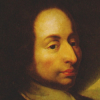
Blaise Pascal
Blaise Pascalwas a French mathematician, physicist, inventor, writer and Christian philosopher. He was a child prodigy who was educated by his father, a tax collector in Rouen. Pascal's earliest work was in the natural and applied sciences where he made important contributions to the study of fluids, and clarified the concepts of pressure and vacuum by generalising the work of Evangelista Torricelli. Pascal also wrote in defence of the scientific method...
NationalityFrench
ProfessionPhilosopher
Date of Birth19 June 1623
CityClermont-Ferrand, France
CountryFrance
[On vanity:] The nose of Cleopatra: if it had been shorter, the face of the earth would have changed.
The world is satisfied with words, few care to dive beneath the surface.
As we speak of poetical beauty, so ought we to speak of mathematical beauty and medical beauty. But we do not do so; and that reason is that we know well what is the object of mathematics, and that it consists in proofs, and what is the object of medicine, and that it consists in healing. But we do not know in what grace consists, which is the object of poetry.
Let us, then, take our compass; we are something, and we are not everything. The nature of our existence hides from us the knowledge of first beginnings which are born of the nothing; and the littleness of our being conceals from us the sight of the infinite. Our intellect holds the same position in the world of thought as our body occupies in the expanse of nature.
It is not in Montaigne, but in myself, that I find all that I see in him.
Those great efforts of intellect, upon which the mind sometimes touches, are such that it cannot maintain itself there. It only leaps to them, not as upon a throne, forever, but merely for an instant.
Vanity is so anchored in the heart of man that a soldier, a soldier's servant, a cook, a porter brags and wishes to have his admirers. Even philosophers wish for them. Those who write against vanity want to have the glory of having written well; and those who read it desire the glory of having read it. I who write this have perhaps this desire, and perhaps those who will read it.
Our senses perceive no extreme. Too much sound deafens us; too much light dazzles us; too great distance or proximity hinders ourview. Too great length and too great brevity of discourse tends to obscurity; too much truth is paralyzing.... In short, extremes are for us as though they were not, and we are not within their notice. They escape us, or we them.
There was once in man a true happiness of which there now remain to him only the mark and empty trace, which he in vain tries to fill from all his surroundings, seeking from things absent the help he does not obtain in things present.
If man were happy, he would be the more so, the less he was diverted, like the saints and God.
Man is clearly made to think. It is his whole dignity and his whole merit; and his whole duty is to think as he ought. And the order of thought is to begin with ourselves, and with our Author and our end.
Eloquence is a painting of thought; and thus those who, after having painted it, add something more, make a picture instead of a portrait.
There is a certain standard of grace and beauty which consists in a certain relation between our nature, such as it is, weak or strong, and the thing which pleases us. Whatever is formed according to this standard pleases us, be it house, song, discourse, verse, prose, woman, birds, rivers, trees, room, dress, and so on. Whatever is not made according to this standard displeases those who have good taste.
Which is the more believable of the two, Moses or China?