Christopher Alexander
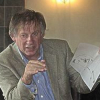
Christopher Alexander
Christopher Wolfgang Alexander is a widely influential architect and design theorist, and currently emeritus professor at the University of California, Berkeley. His theories about the nature of human-centered design have had notable impacts across many fields beyond architecture, including urban design, software, sociology and other fields. Alexander has also designed and personally built over 100 buildings, both as an architect and a general contractor...
NationalityAmerican
ProfessionArchitect
Date of Birth4 October 1936
CountryUnited States of America
The buildings that I build very often have a dreamlike reality. I don't mean by that they have a fantasy quality at all, in fact quite the reverse. They contain in some degree the ingredients that give dreams their power... stuff that's very close to us.
We must face the fact that we are on the brink of times when man may be able to magnify his intellectual and inventive capability, just as in the nineteenth century he used machines to magnify his physical capacity. Again, as then, our innocence is lost. And again, of course, the innocence, once lost, cannot be regained. The loss demands attention, not denial.
In my life as an architect, I found that the single thing which inhibits young professionals, new students most severely, is their acceptance of standards that are too low.
To work our way towards a shared language once again, we must first learn how to discover patterns which are deep, and capable of generating life.
The structure of life I have described in buildings - the structure which I believe to be objective - is deeply and inextricably connected with the human person, and with the innermost nature of human feeling.
People are deeply nourished by the process of creating wholeness.
Nowadays, the process of growth and development almost never seems to manage to create this subtle balance between the importance of the individual parts, and the coherence of the environment as a whole. One or the other always dominates.
Complexity is one of the great problems in environmental design.
It is not possible to make great buildings, or great towns, beautiful places, places where you feel yourself, places where you feel alive, except by following this way. And, as you will see, this way will lead anyone who looks for it to buildings which are themselves as ancient in their form, as the trees and hills, and as our faces are.
There is one timeless way of building. It is a thousand years old, and the same today as it has ever been. The great traditional buildings of the past, the villages and tents and temples in which man feels at home, have always been made by people who were very close to the center of this way.
We are searching for some kind of harmony between two intangibles: a form which we have not yet designed and a context which we cannot properly describe.
The difference between the novice and the master is simply that the novice has not learnt, yet, how to do things in such a way that he can afford to make small mistakes. The master knows that the sequence of his actions will always allow him to cover his mistakes a little further down the line. It is this simple but essential knowledge which gives the work of a master carpenter its wonderful, smooth, relaxed, and almost unconcerned simplicity.
When they have a choice, people will always gravitate to those rooms which have light on two sides, and leave the rooms which are lit only from one side unused and empty.
It is possible to make buildings by stringing together patterns, in a rather loose way. A building made like this, is an assembly of patterns. It is not dense. It is not profound. But it is also possible to put patterns together in such a way that many patterns overlap in the same physical space: the building is very dense; it has many meanings captured in a small space; and through this density, it becomes profound.