Giacomo Leopardi
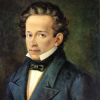
Giacomo Leopardi
Giacomo Taldegardo Francesco di Sales Saverio Pietro Leopardiwas an Italian poet, philosopher, essayist and philologist. He is widely acknowledged to be one of the most radical and challenging thinkers of the 19th century. Although he lived in a secluded town in the ultra-conservative Papal States, he came in touch with the main thoughts of the Enlightenment, and, by his own literary evolution, created a remarkable and renowned poetic work, related to the Romantic era. The extraordinarily lyrical quality of his...
NationalityItalian
ProfessionPoet
Date of Birth29 June 1798
CountryItaly
Giacomo Leopardi quotes about
Man is doomed either squander his youth, which is the only time he has to store provisions for the coming years and provide for his own well-being, or to spend his youth procuring pleasures in advance for that time of life when he will be too old to enjoy them.
He who doubts, knows - knows as much as can be known.
Old age is the supreme evil, for it deprives man of all pleasures while allowing his appetites to remain, and it brings with it every possible sorrow. Yet men fear death and desire old age.
A dictionary can embrace only a small part of the vast tapestry of a language.
Real misanthropes are not found in solitude, but in the world; since it is experience of life, and not philosophy, which produces real hatred of mankind.
He who travels much has this advantage over others – that the things he remembers soon become remote, so that in a short time they acquire the vague and poetical quality which is only given to other things by time. He who has not traveled at all has this disadvantage – that all his memories are of things present somewhere, since the places with which all his memories are concerned are present.
The old man, especially if he is in society in the privacy of his thoughts, though he may protest the opposite, never stops believing that, through some singular exception of the universal rule, he can in some unknown and inexplicable way still make an impression on women.
Every man remembers his childhood as a kind of mythical age, just as every nation's childhood is its mythical age.
The artist's conception of his art or the scientist's of his science is usually as great as his conception of his own worth is small.
I find it awfully difficult to determine if the habit of talking about oneself at length runs contrary to the basic rules of propriety, or if instead the man exempt from this vice is rare.
The end of pain we take as happiness.
Nature, with her customary beneficence, has ordained that man shall not learn how to live until the reasons for living are stolen from him, that he shall find no enjoyment until he has become incapable of vivid pleasure.
I may be wrong, but it seems rare in our age to find a widely praised person whose own mouth is not the source of that praise.
Men do not so much hate an evil-doer, or evil itself, as they hate the man who calls evil by its real name.