Giacomo Leopardi
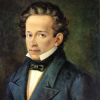
Giacomo Leopardi
Giacomo Taldegardo Francesco di Sales Saverio Pietro Leopardiwas an Italian poet, philosopher, essayist and philologist. He is widely acknowledged to be one of the most radical and challenging thinkers of the 19th century. Although he lived in a secluded town in the ultra-conservative Papal States, he came in touch with the main thoughts of the Enlightenment, and, by his own literary evolution, created a remarkable and renowned poetic work, related to the Romantic era. The extraordinarily lyrical quality of his...
NationalityItalian
ProfessionPoet
Date of Birth29 June 1798
CountryItaly
Giacomo Leopardi quotes about
There's no greater sign of being a poor philosopher and wise man than wanting all of life to be wise and philosophical.
Since the world never faults a man who refuses to yield...it is generally recognized that weak men live in obedience to the world's will, while the strong obey only their own.
In all climates, under all skies, man's happiness is always somewhere else.
Men are ready to suffer anything from others or from heaven itself, provided that, when it comes to words, they are untouched.
Man is doomed either squander his youth, which is the only time he has to store provisions for the coming years and provide for his own well-being, or to spend his youth procuring pleasures in advance for that time of life when he will be too old to enjoy them.
Old age is the supreme evil, for it deprives man of all pleasures while allowing his appetites to remain, and it brings with it every possible sorrow. Yet men fear death and desire old age.
The old man, especially if he is in society in the privacy of his thoughts, though he may protest the opposite, never stops believing that, through some singular exception of the universal rule, he can in some unknown and inexplicable way still make an impression on women.
Every man remembers his childhood as a kind of mythical age, just as every nation's childhood is its mythical age.
I find it awfully difficult to determine if the habit of talking about oneself at length runs contrary to the basic rules of propriety, or if instead the man exempt from this vice is rare.
Nature, with her customary beneficence, has ordained that man shall not learn how to live until the reasons for living are stolen from him, that he shall find no enjoyment until he has become incapable of vivid pleasure.
Men do not so much hate an evil-doer, or evil itself, as they hate the man who calls evil by its real name.
Irresolute men are sometimes very persistent in their undertakings, because if they give up their designs they would have to make a second resolution.
That is why all great men are modest: they consistently measure themselves not in comparison to other people but to the idea of perfection ever present in their minds, an ideal infinitely clearer and greater than any common people have, and they also realize how far they are from fulfilling their ideal.
It's interesting to observe that almost all truly worthy men have simple manners, and that simple manners are almost always taken as a sign of little worth