John Dewey
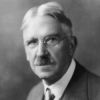
John Dewey
John Deweywas an American philosopher, psychologist, and educational reformer whose ideas have been influential in education and social reform. Dewey is one of the primary figures associated with the philosophy of pragmatism and is considered one of the founders of functional psychology. A Review of General Psychology survey, published in 2002, ranked Dewey as the 93rd most cited psychologist of the 20th century. A well-known public intellectual, he was also a major voice of progressive education and liberalism. Although Dewey...
moving currents moving-in
Knowledge is no longer an immobile solid; it has been liquefied. it is actively moving in all the currents of society itself
learning school mean
Since growth is the characteristic of life, education is all one with growing; it has no end beyond itself. The criterion of the value of school education is the extent in which it creates a desire for continuous growth and supplies means for making the desire effective in fact.
skills use acquisition
The acquisition of skills is not an end in itself. They are things to be put to use, and that use is their contribution to a common and shared life
mean trying identity
While the living thing may easily be crushed by superior force, it none the less tries to turn the energies which act upon it into means of its own further existence. If it cannot do so, it does not just split into smaller pieces (at least in the higher forms of life), but loses its identity as a living thing.
sake distinction mark
There is no greater egoism than that of learning when it is treated simply as a mark of personal distinction to be held and cherished for its own sake. ... [K]knowledge is a possession held in trust for the furthering of the well-being of all
humility humble ifs
If we learn not humility, we learn nothing.
men religion thank-god
For one man who thanks God that he is not as other men there are a thousand to offer thanks that they are as other men, sufficiently as others are to escape attention.
educational philosophy growth
Some experiences are mis-educative. Any experience is mis-educative that has the effect of arresting or distorting the growth of further experience.
In general, every stimulus directs activity. It does not simply excite it or stir it up, but directs it toward an object.
notable renewal distinction
most notable distinction between living and inanimate beings is that the former maintain themselves by renewal.
education children believe
I believe that the school is primarily a social institution. Education being a social process, the school is simply that form of community life in which all those agencies are concentrated that will be most effective in bringing the child to share in the inherited resources of the race, and to use his own powers for social ends. I believe that education, therefore, is a process of living and not a preparation for future living.
exercise thinking rewards
Expertness of taste is at once the result and reward of constant exercise of thinking.
philosophy recovery eye
An empirical philosophy is in any case a kind of intellectual disrobing. We cannot permanently divest ourselves of the intellectual habits we take on and wear when we assimilate the culture of our own time and place. But intelligent furthering of culture demands that we take some of them off, that we inspect them critically to see what they are made of and what wearing them does to us. We cannot achieve recovery of primitive naïveté. But there is attainable a cultivated naïveté of eye, ear and thought.
community individual
Individuals are certainly interested, at times, in having their own way, and their own way may go contrary to the ways of others. But they are also interested, and chiefly interested upon the whole, in entering into the activities of others and taking part in conjoint and cooperative doings. Otherwise, no such thing as a community would be possible.