John Dewey
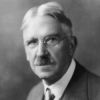
John Dewey
John Deweywas an American philosopher, psychologist, and educational reformer whose ideas have been influential in education and social reform. Dewey is one of the primary figures associated with the philosophy of pragmatism and is considered one of the founders of functional psychology. A Review of General Psychology survey, published in 2002, ranked Dewey as the 93rd most cited psychologist of the 20th century. A well-known public intellectual, he was also a major voice of progressive education and liberalism. Although Dewey...
good-man action manners
Good manners come, as we say, from good breeding or rather are good breeding; and breeding is acquired by habitual action, in response to habitual stimuli, not by conveying information.
government organization democracy
As believers in democracy we have not only the right but the duty to question existing mechanisms of, say, suffrage and to inquire whether some functional organization would not serve to formulate and manifest public opinion better than the existing methods. It is not irrelevant to the point that a score of passages could be cited in which Jefferson refers to the American Government as an experiment.
giving-up military struggle
Resort to military force is a first sure sign that we are giving up the struggle for the democratic way of life, and that the Old World has conquered morally as well as geographically succeeding in imposing upon us its ideals and methods.
democratic-ideals two liberty
Cooperation called fraternity in the classic French formula is as much a part of the democratic ideal as is personal initiative. That cultural conditions were allowed to develop (markedly so in the economic phase) which subordinated cooperativeness to liberty and equality serves to explain the decline in the two latter.
religious school office
One code prevails in the family; another, on the street; a third, in the workshop or store; a fourth, in the religious association. As a person passes from one of the environments to another, he is subjected to antagonistic pulls, and is in danger of being split into a being having different standards of judgment and emotion for different occasions. This danger imposes upon the school a steadying and integrating office.
thinking peculiar research
We sometimes talk as if "original research" were a peculiar prerogative of scientists or at least of advanced students. But all thinking is research, and all research is native, original, with him who carries it on, even if everybody else in the world already is sure of what he is still looking for.
realization demand method
If there is one conclusion to which human experience unmistakably points it is that democratic ends demand democratic methods for their realization.
spring war class
Even the alleged benefits of war, so far as more than alleged, spring from the fact that conflict of peoples at least enforces intercourse between them and thus accidentally enables them to learn from one another, and thereby to expand their horizons. Travel, economic and commercial tendencies, have at present gone far to break down external barriers; to bring peoples and classes into closer and more perceptible connection with one another.
mean desire used
The end justifies the means only when the means used are such as actually bring about the desired and desirable end.
aliens nurturing various
By various agencies, unintentional and designed, a society transforms uninitiated and seemingly alien beings into robust trustees of its own resources and ideals. Education is thus a fostering, a nurturing, a cultivating, process.
children curiosity mind
With respect to the development of powers devoted to coping with specific scientific and economic problems we may say that the child should be growing in manhood. With respect to sympathetic curiosity, unbiased responsiveness, and openness of mind, we may say that the adult should be growing in childlikeness.
art philosophy divorce
The very problem of mind and body suggests division; I do not know of anything so disastrously affected by the habit of division as this particular theme. In its discussion are reflected the splitting off from each other of religion, morals and science; the divorce of philosophy from science and of both from the arts of conduct. The evils which we suffer in education, in religion, in the materialism of business and the aloofness of "intellectuals" from life, in the whole separation of knowledge and practice -- all testify to the necessity of seeing mind-body as an integral whole.
art judging perception
The function of criticism is the reeducation of perception of works of art? The conception that its business is to appraise, to judge in the legal and moral sense, arrests the perception of those who are influenced by the criticism that assumes this task.
plato men slavery
Plato defined a slave as one who accepts from another the purposes which control his conduct. This condition obtains even where there is no slavery in the legal sense. It is found wherever men are engaged in activity which is socially serviceable, but whose service they do not understand and have no personal interest in.